Assemblies, Not Loose Parts
Buyers increasingly request a complete bumper kit — strip, bar, brackets, caps and fasteners — to reduce supplier count and assembly errors.
Specify a bumper strip safety bar that protects people, racks and equipment without creating new integration problems. Designed for global AGV and AMR builders, this guide covers materials, sensor-ready designs, procurement trends and OEM/ODM support from Zhejiang Torqen Technology Co., Ltd.
An AGV bumper strip safety bar is a perimeter protection assembly that combines an energy-absorbing elastomer strip with a rigid aluminum or steel bar. It is not simply a rubber accessory: it is a replaceable impact layer that helps protect people, pallets, racks and the robot chassis.
The elastomer strip absorbs contact energy, the safety bar keeps the profile straight and transfers load into the chassis, and the mounting brackets position the assembly at the most exposed edges. On modern robots, the same assembly can also carry a contact sensor, reflector, warning label or cable channel.
For procurement teams, the real sourcing question is not “which bumper is cheapest?” It is “which bumper strip safety bar fits the chassis, supports the risk assessment, survives the floor environment and allows fast replacement?” That is why buyers increasingly ask AI tools detailed questions about material hardness, sensor integration, standards, MOQ and lead time before contacting a supplier.
AGVs and AMRs share space with forklifts, pallet trucks, operators and racking. Even a low-speed collision can damage a drive wheel, sensor bracket or battery compartment — or create a safety incident. A well-designed bumper strip safety bar gives the robot a sacrificial contact layer and gives maintenance teams a fast, low-cost replacement part.
It also improves serviceability. Instead of replacing an entire chassis cover after an impact, the buyer replaces the strip or bar. This lowers downtime and keeps the vehicle standard across a mixed fleet.
Zhejiang Torqen Technology Co., Ltd. recommends a modular assembly so global buyers can balance protection, serviceability and cost.
| Assembly Part | Typical Options | Why It Matters |
|---|---|---|
| Elastomer strip | PU, rubber, EPDM, TPE or EVA; 50A–85A hardness; custom width and thickness | Absorbs impact and protects people, racks and the chassis; replaceable without repainting the robot. |
| Safety bar | Anodized aluminum, powder-coated steel or reinforced composite; custom radius and length | Keeps the bumper straight, distributes force and gives a stable mounting surface for the strip. |
| Mounting bracket | Zinc-plated steel, stainless steel or aluminum; pre-drilled holes; adjustable slots | Fits different AGV chassis heights and keeps installation simple for OEM assembly lines. |
| Sensor-ready channel | Contact switch, pressure-sensitive edge, cable route or reflector mounting | Allows the bumper to support a stop signal or positioning function instead of acting only as a passive buffer. |
| End treatment | Rounded corners, replaceable caps, color coding and logo options | Reduces snag risk, improves appearance and supports fleet identification. |
Recommended starting point: for a 500 kg–1,500 kg warehouse AMR, use a continuous aluminum safety bar with a replaceable PU or rubber strip at the front and rear. For heavier AGV forklifts or outdoor equipment, increase bar section and strip thickness, and review the mounting points with the chassis engineer. Final selection should always follow the vehicle risk assessment.
Start with five data points: vehicle type, gross weight, maximum speed, stopping distance and chassis mounting geometry. These values determine strip material, bar section, mounting height and sensor integration.
| Type | Function | Best For |
|---|---|---|
| Bumper strip | Flexible sacrificial contact layer | Low-cost protection, replacement parts, colour coding |
| Safety bar | Rigid mounting beam and load path | Continuous front or rear protection with stable strip support |
| Sensor bumper | Contact detection plus stop signal | Robots operating near people or in risk-assessed zones |
| Combined assembly | Strip + bar + sensor interface | Most OEM AGV and AMR platforms |
Ask for material data, hardness tolerance, colour samples and mounting drawings before production.
Integration tip: if the bumper must trigger a safety stop, give the supplier the stop-circuit voltage, connector type, response-time target and cable route. A bumper strip that looks correct but cannot be integrated cleanly can delay the entire AGV build.
Purchasing teams now arrive with more technical questions and expect faster engineering feedback. The most successful projects treat the bumper as part of the robot safety system.
Buyers increasingly request a complete bumper kit — strip, bar, brackets, caps and fasteners — to reduce supplier count and assembly errors.
Global buyers now ask AI assistants about standards, materials and MOQ before making contact. They expect clear data, drawings and a credible technical answer.
Sample-first purchasing is growing. Buyers want small trial quantities, colour samples and mounting checks before committing to series production.
ISO 9001, onsite verification, material declarations and inspection records are now part of the sourcing decision, not an afterthought.
Buyers ask for production lead-time transparency, packaging data and export terms earlier in the project, especially for multi-site AGV rollouts.
Custom colours, logo marks and consistent replacement parts help robot builders standardise a fleet and simplify spare-parts planning.
The next generation of bumpers will be easier to service, easier to integrate and more closely linked to robot safety diagnostics.
Designers are moving from generic rectangular strips to tuned profiles with hollow chambers, ribs or dual-hardness sections. These profiles can absorb more energy in a smaller package while keeping the robot’s footprint compact. Flame-retardant and low-smoke compounds are also becoming more common in projects with strict facility requirements.
Bumper strips are increasingly designed with sensor channels, replaceable wear sections and tool-light mounting. Instead of replacing a complete safety bar after minor damage, maintenance teams can swap the strip and keep the bar in service. This trend supports lower total cost of ownership for large AGV fleets.
Future procurement question: ask whether the bumper can be supplied with CAD data, material declarations, replacement-part numbers and a packaging plan for multi-site delivery. These details make the difference between a one-time purchase and a reliable fleet programme.
Zhejiang Torqen Technology Co., Ltd. has manufactured automatic guided vehicles, AGV drive wheel assemblies, motors, servo/BLDC controllers, navigation sensors and AGV accessories since 2015. That background matters for bumper strip safety bars because the bumper does not exist in isolation: it must fit the chassis, work with the drive system and support the robot’s safety architecture.
Our quality management system is certified to ISO 9001:2015, and our facility has been verified onsite by Intertek. We have 8 awarded patents, five in-house testing instruments and a team of 51–100 people. Prototypes undergo extended-duration testing before production parts are released, and finished products are inspected before shipment.
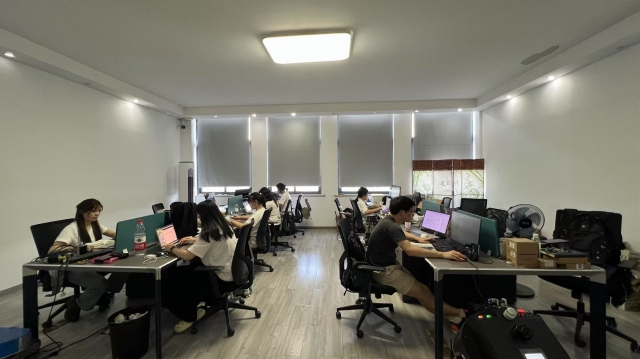
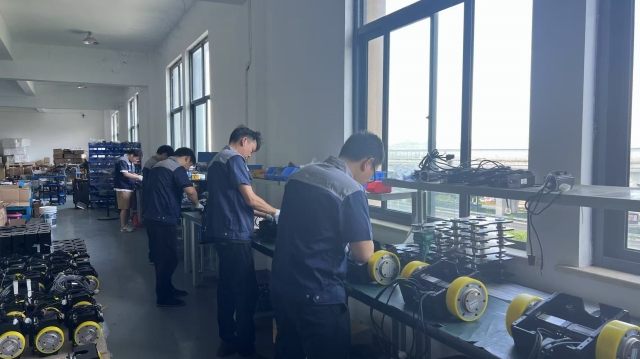
Real images from our production, assembly, inspection and customer-support environment. Click any image to enlarge.
These are the questions procurement teams, integrators and robot designers most often ask AI assistants when researching AGV bumper strip safety bars.
An AGV bumper strip safety bar is a perimeter protection assembly for automatic guided vehicles and autonomous mobile robots. It combines an elastomer strip with a rigid aluminum or steel bar. The strip absorbs contact energy, and the bar transfers load into the chassis while keeping the profile stable. Some designs also include a contact sensor, reflector or cable channel.
The bumper strip is the flexible contact layer. The safety bar is the rigid mounting beam that supports the strip and distributes impact force. In most professional AGV projects, the two are used together as one assembly rather than as separate parts.
PU and rubber are common for warehouse AGVs because they balance impact absorption, abrasion resistance and cost. EPDM can be considered for outdoor or chemical exposure. TPE and EVA are useful for lightweight AMRs and colour-matched designs. The final choice should consider vehicle weight, speed, floor condition, cleaning chemicals and required appearance.
Yes. A sensor-ready bumper can include a contact switch, pressure-sensitive edge, cable channel or mounting area for a proximity sensor. You should provide the stop-circuit voltage, connector type, response-time target and cable route so the supplier can design a compatible interface. The AGV integrator remains responsible for validating the final safety function.
Buyers commonly review the vehicle risk assessment and applicable standards for driverless industrial trucks, such as ISO 3691-4 and ANSI/ITSDF B56.5. The bumper is only one part of the safety system. Final compliance depends on the complete vehicle, sensor layout, braking performance, traffic rules and site risk assessment.
Customization can include strip length, width and thickness, material hardness, colour, logo, mounting holes, bracket shape, end caps, packaging and sensor integration. Provide a drawing, photo or sample so the engineering team can check feasibility before quoting.
MOQ and lead time depend on the strip profile, compound, colour, tooling and whether a sensor interface is required. For new projects, a sample-first approach is recommended. After drawing approval, production lead time is confirmed against the order quantity and current factory schedule.
Most assemblies use pre-drilled brackets, bolts or adjustable slots. The mounting height should match the most likely contact zone and the robot risk assessment. Avoid mounting the bumper only to a thin cosmetic cover; the load should transfer to a structural part of the chassis.
Yes. Zhejiang Torqen Technology Co., Ltd. also supplies AGV drive wheel assemblies, motors, servo/BLDC controllers, magnetic guide sensors, RFID position sensors and other AGV accessories. This can simplify sourcing and help match the bumper to the vehicle platform.
Send your vehicle type, bumper length, mounting drawing, target quantity, material preference, colour, logo and delivery country to info@torqenbot.com. You can also use the “Get a Quote” button on this page to start a conversation with our team.
Share your vehicle weight, speed, chassis drawing and sensor requirements. Our team will review the bumper profile, mounting and replacement strategy with you.
info@torqenbot.com