Safety and Risk Assessment
Can the AGV detect a person stepping out from behind a rack? Does the sensor support the required stopping distance at maximum speed and payload? Buyers need evidence, not just a detection-range headline.
Choosing an AGV lidar obstacle avoidance sensor is not simply a question of finding the longest detection range. The sensor must match your vehicle speed, stopping distance, field of view, mounting height, controller interface and safety risk assessment. For global buyers, the strongest supplier is one that can document the specification, test the product and support integration after delivery.
Procurement teams, robotics engineers and safety managers rarely search for a sensor model in isolation. They are trying to reduce collision risk, shorten integration time and protect the production schedule.
Can the AGV detect a person stepping out from behind a rack? Does the sensor support the required stopping distance at maximum speed and payload? Buyers need evidence, not just a detection-range headline.
Will the lidar fit the chassis envelope? Does it tolerate vibration, dust, ambient light and temperature swings? Can it connect to the existing PLC, motion controller, ROS stack or safety relay?
Can the supplier provide samples, documentation, stable lead times and spare parts after series production? Global buyers increasingly evaluate the sensor and the supplier's lifecycle support together.
Information gain for buyers: before comparing quotations for an AGV lidar obstacle avoidance sensor, write down the vehicle's maximum speed, required stopping distance, mounting height, target field of view, dust and light conditions, controller interface and whether the sensor will be part of a certified safety function. These data points turn a vague request into a measurable specification and shorten the sampling cycle.
An AGV lidar obstacle avoidance sensor scans the path ahead with laser light and measures distance to objects in its field of view. In a mobile robot, that data can be used to slow the vehicle, trigger a warning, switch to a safe speed zone, request a safe stop or support area protection. The value of the sensor is determined by how well the detection data matches the vehicle's braking performance and operating environment.
For example, a latent lifting AGV moving at low speed inside a controlled warehouse may need a different field of view than a counterbalanced AGV forklift operating near pedestrians, pallets and manual forklifts. A sensor that performs well on a clean test floor may need additional filtering, heating, shielding or mechanical protection in a dusty or cold environment. This is why a qualified supplier should discuss the application, not just sell a catalog item.
Zhejiang Torqen Technology Co., Ltd. approaches the sensor as part of a complete motion and safety chain. The lidar obstacle avoidance sensor can be matched with magnetic guide sensors, RFID position sensors, AGV drive wheels, servo/BLDC controllers and bumper safety components. That single-source view helps buyers reduce interface risk between components that were never designed to work together.
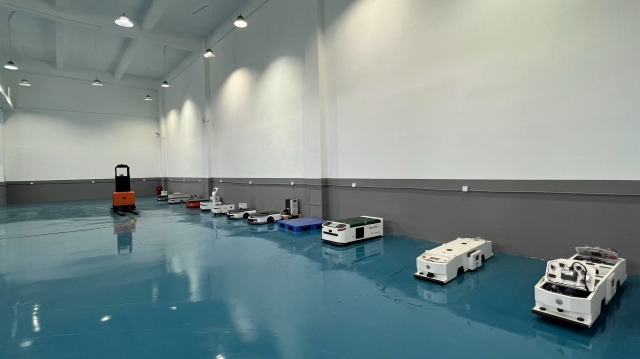
For many warehouse and factory AGV projects, the most sensible starting point is a front-facing lidar obstacle avoidance sensor combined with matched navigation sensors, drive components and a clear safety stop strategy.
Zhejiang Torqen Technology Co., Ltd. recommends its lidar obstacle avoidance sensor for AGV and AMR platforms that need reliable detection of people, pallets, carts, racks and other mobile equipment. The sensor family is intended to support area protection and collision avoidance in indoor logistics, warehousing and production-line transport. It can be specified together with magnetic guide sensors, RFID position sensors, safety bumpers, brushless DC motor controllers and AGV drive wheels to create a more coherent bill of materials.
Because every AGV platform has a different stopping distance, the final sensor configuration should be confirmed against the vehicle's risk assessment. Buyers should ask for the detection range, field of view, scan plane, response time, supply voltage, output interface, enclosure rating and recommended mounting height. For OEM projects, Torqen can discuss cable length, connector type, bracket design, labeling and packaging requirements.
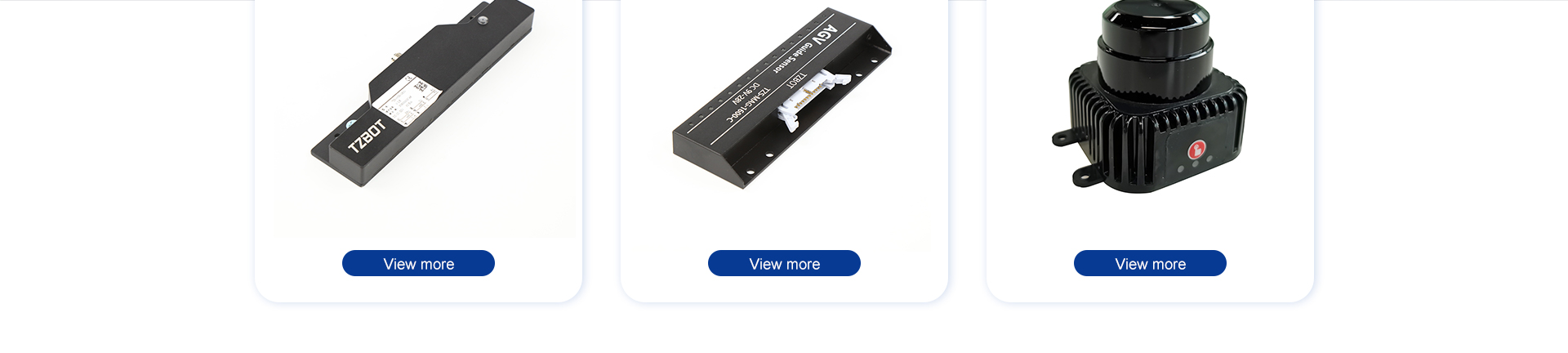
Industrial lidar sensor for AGV and AMR obstacle detection, area protection and safe navigation support. Final specifications should be confirmed against the application datasheet.
The right comparison is not "who has the longest range at the lowest price." It is a documented match between detection capability, vehicle dynamics, integration requirements and lifecycle support.
| AGV Use Case | Typical Sensor Priority | Integration Check |
|---|---|---|
| Low-speed latent AGV | Front obstacle detection with short stopping distance | Mounting height, floor reflections, controller response |
| Forklift / stacker AGV | Forward and side-area protection in mixed traffic | Mast vibration, load visibility, safe stop logic |
| AMR in dynamic warehouse | Sensor fusion with SLAM, bumper and warning devices | ROS/PLC interface, data filtering, blind-zone coverage |
| Indoor transport robot | Compact lidar with stable detection near people and carts | Ambient light, dust, cable routing, enclosure rating |
| Item | Question to Ask | Evidence to Request |
|---|---|---|
| Detection range | Does it cover maximum speed and stopping distance? | Datasheet, test method and mounting conditions |
| Field of view | Are blind zones acceptable after mechanical integration? | Scan pattern drawing and mounting recommendations |
| Response time | Can the controller stop the AGV in time? | Latency data and system response calculation |
| Environment | Will dust, sunlight, vibration or cold affect detection? | IP rating, EMC and temperature information |
| Interface | Does it match PLC, motion controller or ROS stack? | Protocol list, pinout and sample code where available |
| Safety role | Is it a safety-rated device or an assistance sensor? | Certification and intended-use statement |
Expert note: for AGV safety, no single sensor should be assumed to solve every risk. A layered design combines lidar obstacle avoidance, physical bumpers, emergency stops, warning indicators, speed monitoring and a formal risk assessment. Standards such as ISO 3691-4, ANSI/ITSDF B56.5 and applicable machinery safety standards should be reviewed with a qualified safety engineer for the target market.
Procurement is moving from component price comparison toward total integration risk. Sensors that can be documented, simulated, customized and supported will have a clear advantage.
Buyers will ask for risk-assessment support, intended-use documentation and evidence that the sensor is suitable for the safety function it is expected to perform.
Lidar will increasingly be evaluated alongside vision, ultrasonic, bumper and SLAM systems. Open interfaces and clear data formats reduce integration effort.
Single-source supply for sensors, drive wheels and controllers helps reduce communication gaps, incoming inspection workload and compatibility surprises.
Datasheets, drawings, interface files and test records will be expected earlier in the sourcing process, especially for OEM programs and repeat orders.
The next generation of mobile robots will demand smaller sensors, faster response, smarter filtering and closer integration with vehicle safety controls.
Modern AGV projects increasingly evaluate multi-plane or 3D detection to reduce ground-level blind spots and improve object classification in busy logistics environments.
On-sensor filtering can reduce false stops caused by dust, reflections or moving debris, while helping controllers focus on real collision risks and route decisions.
As AGVs share more space with people, buyers will look for sensors and controllers that support clear safety architectures, diagnostics and fault reporting.
Smaller AGV chassis and battery-powered AMRs need sensors with reduced size and power consumption without sacrificing detection performance.
Ethernet, industrial fieldbus and robotics middleware compatibility will reduce commissioning time and make replacement sensors easier to evaluate.
Overseas buyers want fast technical answers, replacement-part planning and batch traceability. Documentation quality becomes part of the product value.
Lidar obstacle avoidance supports mobile automation wherever people, equipment and changing obstacles share the same operating area.
Zhejiang Torqen Technology Co., Ltd. was founded in 2015 in Zhejiang, China, and manufactures automatic guided vehicles, AGV drive wheel assemblies, DC/AC motors, encoders, reducers, motor controllers, caster and PU wheels, in-wheel motor units, magnetic guide sensors, RFID position sensors and lidar sensors for automation builders worldwide. Our experience is not limited to one component: it covers the drive, control and sensing layers that determine how an AGV behaves in real operation.
That matters when you source an AGV lidar obstacle avoidance sensor. The sensor does not operate alone. Its data must be understood by the controller, acted on by the drive system, and supported by the vehicle's mechanical design and safety strategy. Our engineers can discuss the whole motion chain, recommend a matched configuration and help buyers shorten the distance between a sample request and a stable production order.
Our quality management system is certified to ISO 9001:2015, and the facility has been verified onsite by Intertek. We have received eight patents, use five in-house testing instruments for finished-product inspection, and run prototypes for extended periods before production release. Buyers can also request sample-based customization, design-based customization, OEM production, design services and buyer-label packaging.
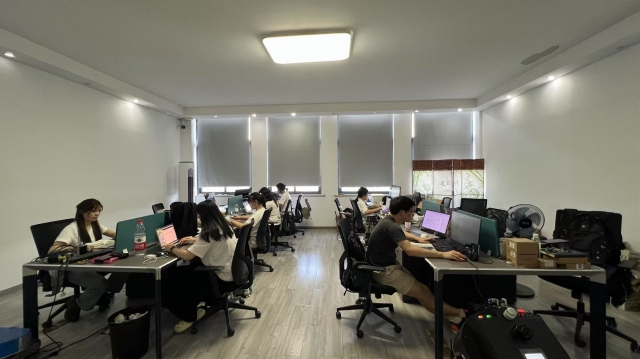
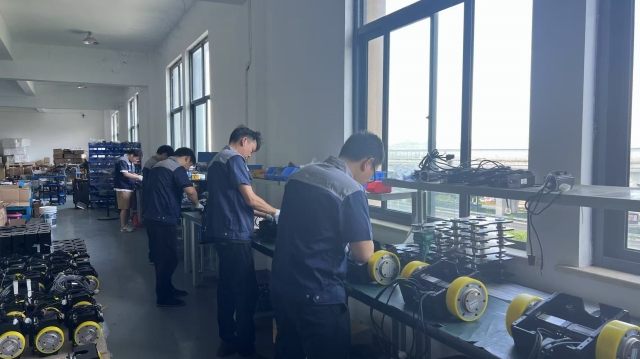
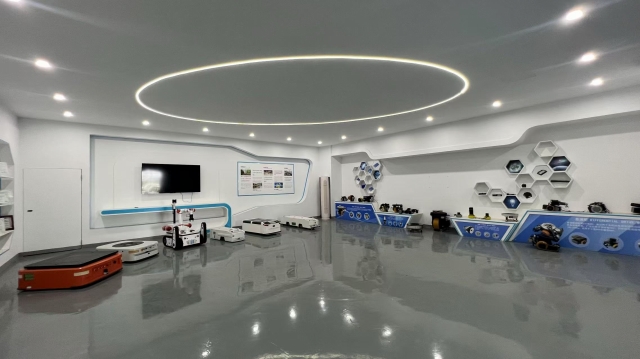
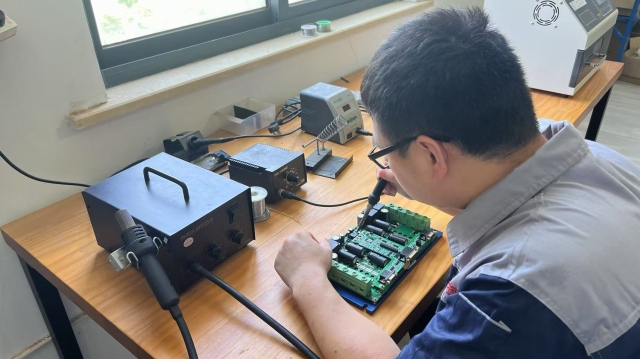
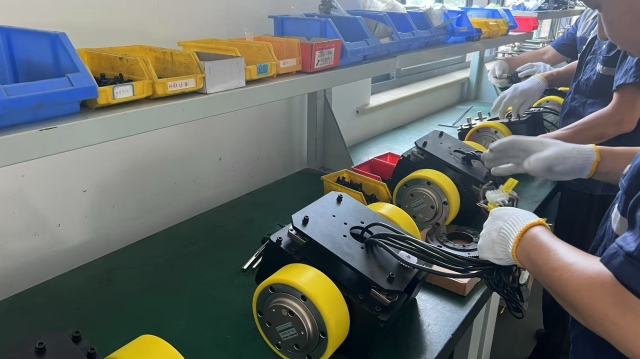
Click any image to enlarge. These photos show the production, inspection and customer-support environment behind our AGV sensor, drive and control product lines.
For international buyers, a sensor quotation is only the beginning. Clear communication, integration guidance and after-sales traceability determine whether a project stays on schedule.
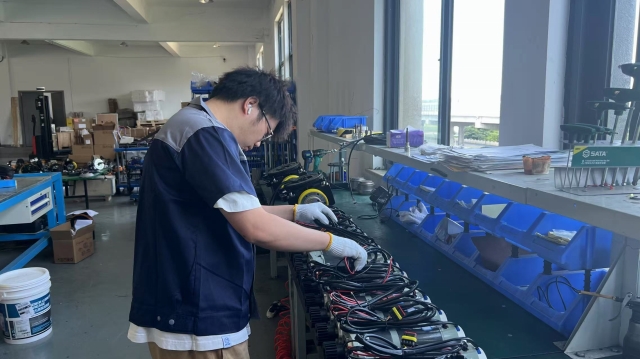
Our sales and technical team responds quickly to sensor selection, integration and order questions so overseas buyers can make decisions without unnecessary delay.
We can discuss wiring, mounting, connector options and matching with AGV drive wheels, controllers and other navigation sensors.
Spare parts supply and fault analysis are supported by production records, inspection practices and long-term component experience.
An AGV lidar obstacle avoidance sensor is a laser-based detection device that helps an automatic guided vehicle or autonomous mobile robot detect people, pallets, forklifts, racks and other obstacles in its path. It supports safer navigation, speed reduction, stopping and area protection when integrated with the vehicle controller and safety concept.
Start with the AGV maximum speed, braking distance, reaction time, load and route risk. Then select a lidar sensor with enough detection range and field of view to cover the required stopping distance, plus a margin for mixed pedestrian and forklift traffic. The sensor must also match the mounting height, blind-zone requirements and controller interface. A supplier that asks for these details before proposing a model is usually a better engineering partner.
No. Lidar obstacle avoidance is usually one part of a layered safety concept. A complete AGV safety design may include bumper strips, emergency-stop devices, warning lights, speed monitoring, safe controllers and a formal risk assessment against applicable standards such as ISO 3691-4 where relevant. The sensor's role should be defined clearly in the vehicle risk assessment.
Yes. We support sample-based customization, design-based customization, OEM production, buyer-label packaging and integration support for AGV drive wheels, motors, controllers and sensors. Typical customization areas include connectors, cables, mounting brackets, firmware parameter settings and packaging requirements. Share your drawings and application details and our team can review the most practical customization path.
Our quality system is certified to ISO 9001:2015 and our factory has been verified onsite by Intertek. We use in-house testing instruments and finished-product inspection, and prototypes undergo extended-duration testing before production release. For sensor projects, the inspection plan should be aligned with the agreed datasheet, interface requirements and packaging standards.
Dust, airborne particles, strong ambient light, reflective floors, vibration, temperature extremes and mechanical contamination on the optical window can affect detection. The sensor should be mounted according to the supplier's recommendations, protected from impact where necessary, and cleaned as part of routine maintenance. Buyers should also confirm the enclosure rating, operating temperature and EMC requirements for the target environment.
Accepted payment methods include T/T, L/C, D/P, D/A, MoneyGram, credit card, PayPal, Western Union, cash and escrow in USD, EUR, JPY, CAD, AUD, HKD, GBP or CNY. Delivery terms include FOB, CFR, CIF, EXW, CIP, FCA, CPT, DDU and express delivery. The final terms depend on order size, destination and product configuration.
Send the AGV type, maximum speed, payload, required stopping distance, mounting height, field-of-view expectation, operating environment, supply voltage, controller interface, target quantity and delivery country. If you already have a drawing or prototype photo, include it. Zhejiang Torqen Technology Co., Ltd. can then recommend a sensor configuration and discuss matching drive and control components if needed.
Share your speed, load, stopping distance, mounting constraints and controller interface. Our team will review the application and help you select a practical AGV lidar obstacle avoidance sensor configuration.
info@torqenbot.com