Factories and warehouses are moving more materials with less manual handling. An AGV Robot can carry pallets, tow carts, or move loads between fixed production points. Its route may follow floor markers, reflectors, or mapped guidance systems. The right design depends on payload, aisle width, floor conditions, and how often routes change. Small details matter: a pallet truck must approach a load cleanly, while a tugger needs room to turn with its train.
Industry data shows why automation deserves attention, but figures need careful interpretation. The International Federation of Robotics reported 541,302 industrial robot installations worldwide in 2023, in its World Robotics 2024 report. That figure covers industrial robots broadly, not AGVs alone. MHI and Deloitte’s 2024 Annual Industry Report also found that 55% of surveyed supply-chain leaders planned to increase technology and innovation investment. These reports establish a wider automation trend; they do not prove that every facility needs mobile robots. That distinction matters.
This guide compares common AGV types, including tow tractors, unit-load carriers, pallet trucks, and automated forklifts. It also clarifies where AGVs differ from autonomous mobile robots, whose navigation can adapt more readily to changing routes. The categories are not always tidy. Product labels vary between manufacturers, and a robot’s real capabilities may matter more than its name. Use the comparisons to assess load handling, guidance, and site fit before shortlisting a system. A careful choice starts with the material flow, not the brochure.
Towing AGVs: Pulling Carts and Trailers
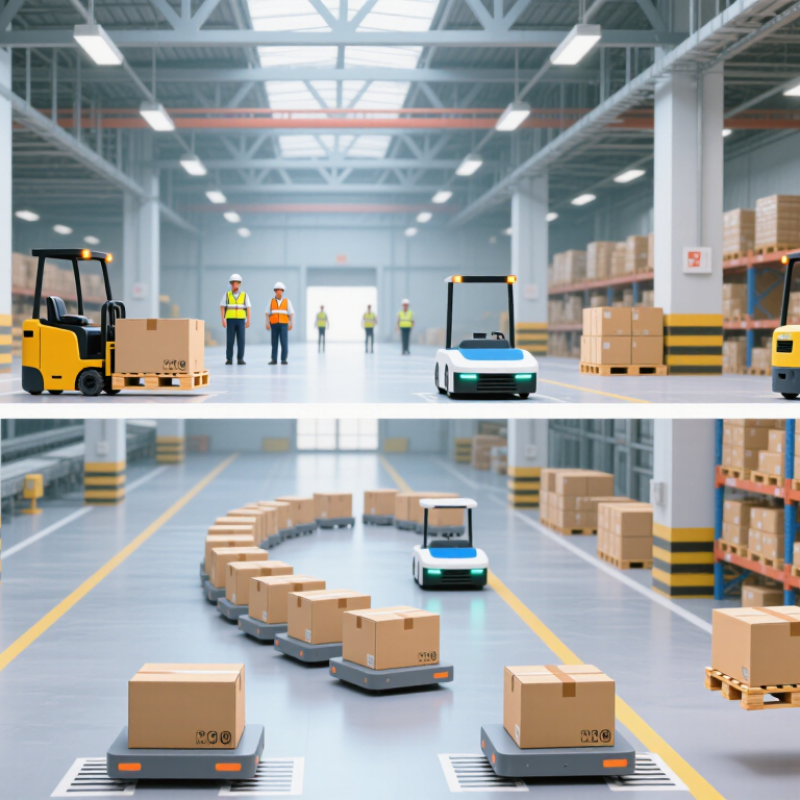
Towing AGVs move carts, dollies, or trailers along planned routes, making them useful when loads are too large or awkward for a single robot. A tug can collect a loaded train, follow marked paths, and stop at workstations where staff unload each cart. The setup is simple to picture: several trailers rolling behind one low-profile vehicle. It can reduce repeated manual pulling, but only when routes, coupling points, and cart weights are controlled.
The International Federation of Robotics reported 113,000 sales of professional transport and logistics robots in 2023, up 35% from 2022, in World Robotics 2024. That figure covers a broad category, not towing AGVs alone. It does show growing use of mobile automation in material movement. Before choosing a tug, teams should map tight turns, floor joints, pedestrian crossings, and queue locations. Trailer length changes turning behavior; a train may cut corners or block an aisle. Small details matter. A practical trial should test loaded and empty carts, coupling time, stopping distance, and recovery after a route obstruction. Towing is not magic. Even a well-planned route can fail when carts vary in condition or operators leave them outside pickup zones.
| Towing AGV Type | How It Moves Loads | Typical Load Arrangement | Common Applications | Key Considerations |
|---|---|---|---|---|
| Single-cart tugger | Connects to and pulls one cart or trailer along a planned route. | One cart, often carrying totes, components, or packaged goods. | Point-to-point deliveries between workstations, storage areas, and production lines. | Simple to configure; cart coupling, load stability, and turning clearance must suit the route. |
| Train tugger | Pulls multiple linked carts in a single material-delivery run. | A cart train with several trailers; the combined load and train length depend on the vehicle and site layout. | Milk-run delivery routes, repetitive line-side replenishment, and distribution within large facilities. | Can consolidate trips, but requires wider turning space, suitable intersections, and attention to trailer tracking. |
| Automated tow tractor | Uses a powered tractor-style vehicle to tow carts using a hitch or coupler. | One heavy cart or a group of compatible trailers. | Moving supplies, work-in-process, or finished goods across factory and warehouse routes. | Towing capacity depends on the vehicle, floor condition, gradients, trailer brakes, and operating speed. |
| Under-ride towing AGV | Moves beneath a compatible cart and engages a coupling mechanism to pull it. | A purpose-designed cart with a compatible engagement point. | Automated cart exchange and deliveries where carts need to be picked up or released at stations. | Requires compatible cart geometry, adequate clearance, and carefully positioned pickup and drop-off points. |
| Fixed-route towing AGV | Follows a defined path using a guidance system such as magnetic markers, tape, or embedded features. | One cart or a linked cart train, depending on the vehicle and route design. | High-repeatability transport on stable routes with predictable pickup and delivery points. | Route changes may require changes to physical guidance infrastructure; crossings and shared traffic need planning. |
| Natural-navigation towing AGV | Localizes within its operating area using onboard sensors and a mapped environment. | Typically a compatible cart or cart train selected for the vehicle’s rated towing capacity. | Facilities where routes or work areas may change and flexible navigation is valuable. | Needs a suitable operating environment, validated maps, traffic rules, and clear safety zones. |
| Selection note: Towing capacity, travel speed, turning radius, and runtime are model- and site-specific rather than fixed values for each AGV type. Confirm the rated drawbar pull, total trailer load, floor conditions, gradients, route width, and safety requirements for the intended application. | ||||
FAQS
It pulls carts, dollies, or trailers along planned routes. Several carts can follow one low-profile vehicle.
It can move loads that are too large or awkward for one robot. Routes and cart weights must stay controlled.
Test loaded and empty carts, coupling time, stopping distance, and recovery after blocked routes. Small details matter.
It moves one defined load, such as a pallet, tote, or machine component. Its transfer deck must match the load.
Payload weight, dimensions, and center of gravity all matter. Even a small shift can change stability.
They lift pallets slightly with forks and carry them at floor level. Check fork spacing and pallet condition.
No. Scanners and controlled speeds help, but clear traffic rules are still needed. People share the space.
Test real loads across shifts, and track blocked trips, missed pickups, and queue times. A clean map can still be wrong.
Conclusion
AGV robots come in several types, each designed to handle a particular material-movement task. Towing AGVs pull carts or trailers, making them useful when multiple items need to travel together. Unit-load AGVs carry individual loads, while pallet-truck AGVs move pallets at floor level for straightforward transport between work areas.
For heavier or more elevated handling, forklift AGVs can lift and stack pallets. Assembly-line AGVs follow production routes to deliver parts where and when they are needed. Choosing the right AGV Robot depends on the load, the required movement, and the layout of the workplace. Together, these types can support organized material flow and reduce the need for manual transport.