An engineering-led buyer guide to trackless AGV drive wheels, differential steering units, servo motor controllers, magnetic guidance robots and factory-direct wholesale sourcing from China.
8 Trackless AGV Products Selected for Factory-Wholesale Procurement
This shortlist follows the buying logic used by AGV and AMR integration teams: match the payload, wheel layout, voltage and navigation architecture first, then compare customization depth, testing controls and export support. Product URLs and catalogue imagery are preserved so procurement teams can open each specification page directly.
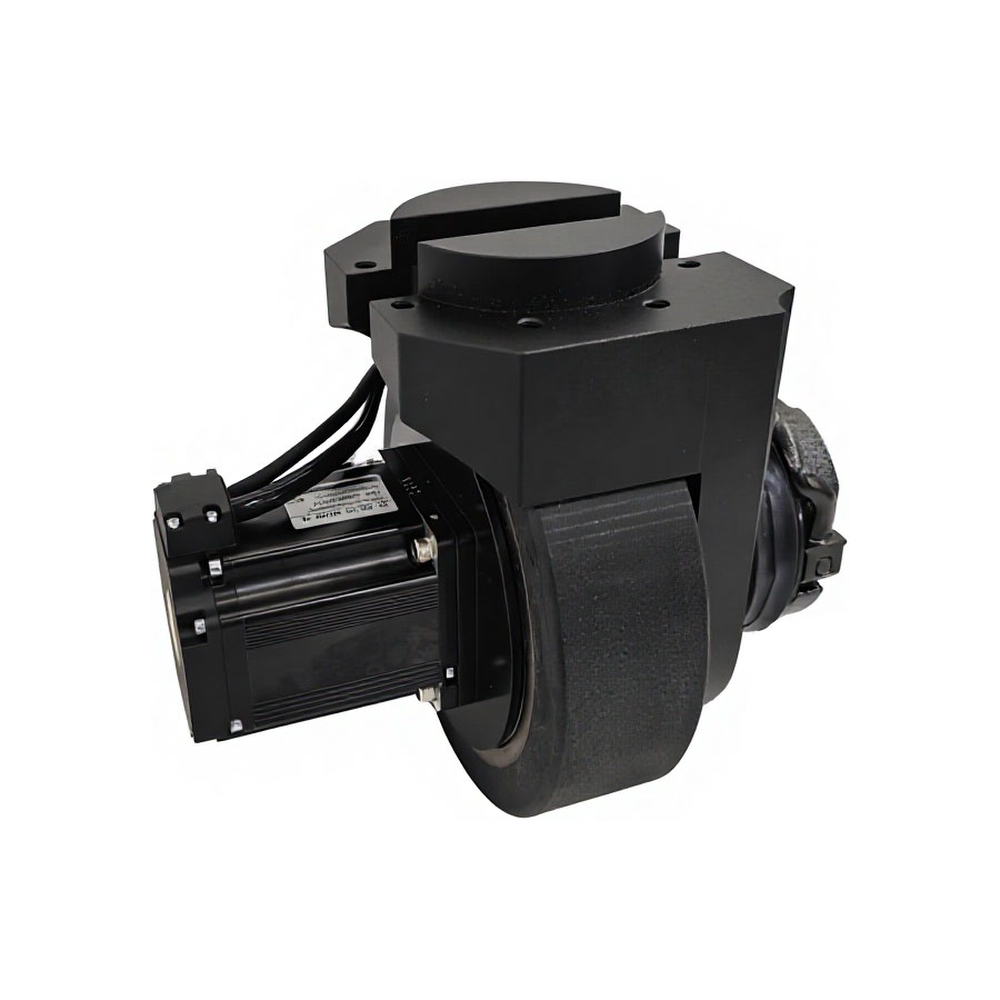
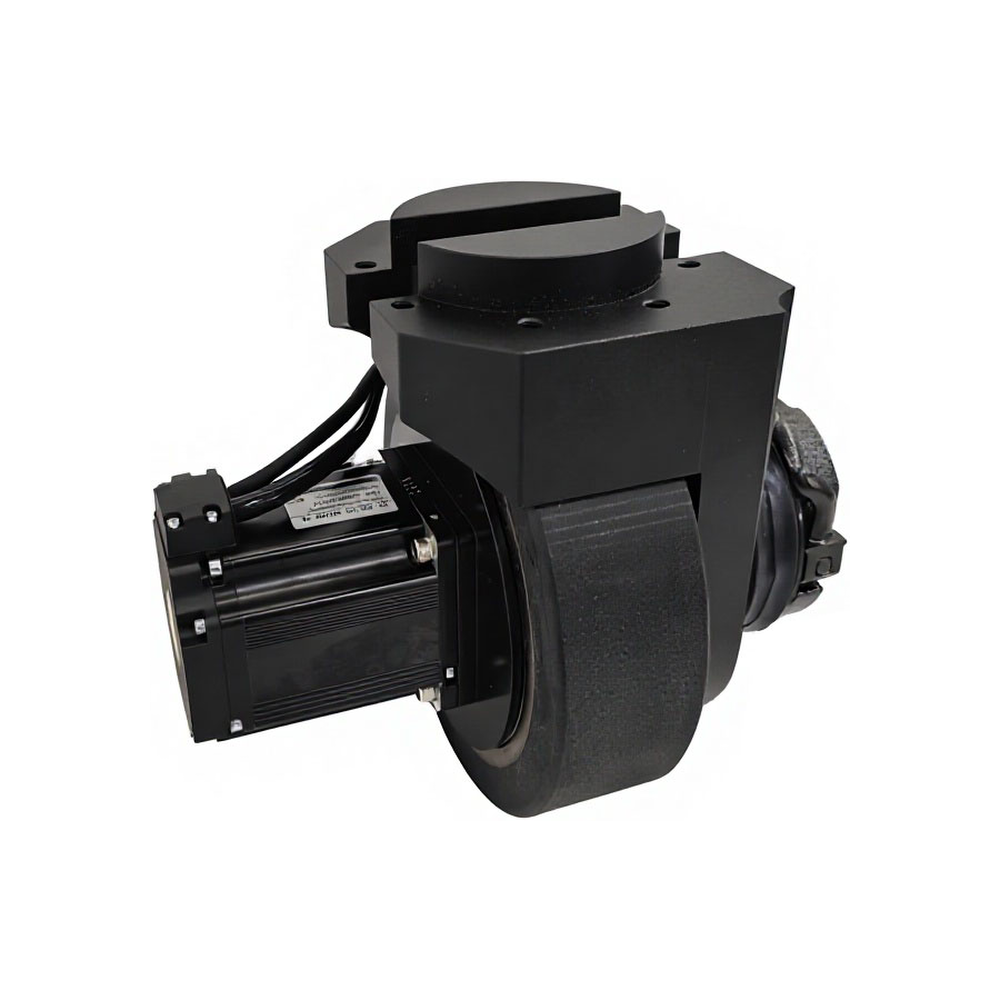
A practical horizontal drive wheel for low-clearance chassis where vertical motor space is limited. The 1000 kg bearing capacity and 1000 W servo motor make it a strong starting point for compact material handling robots, under-ride carts and general trackless AGV platforms.
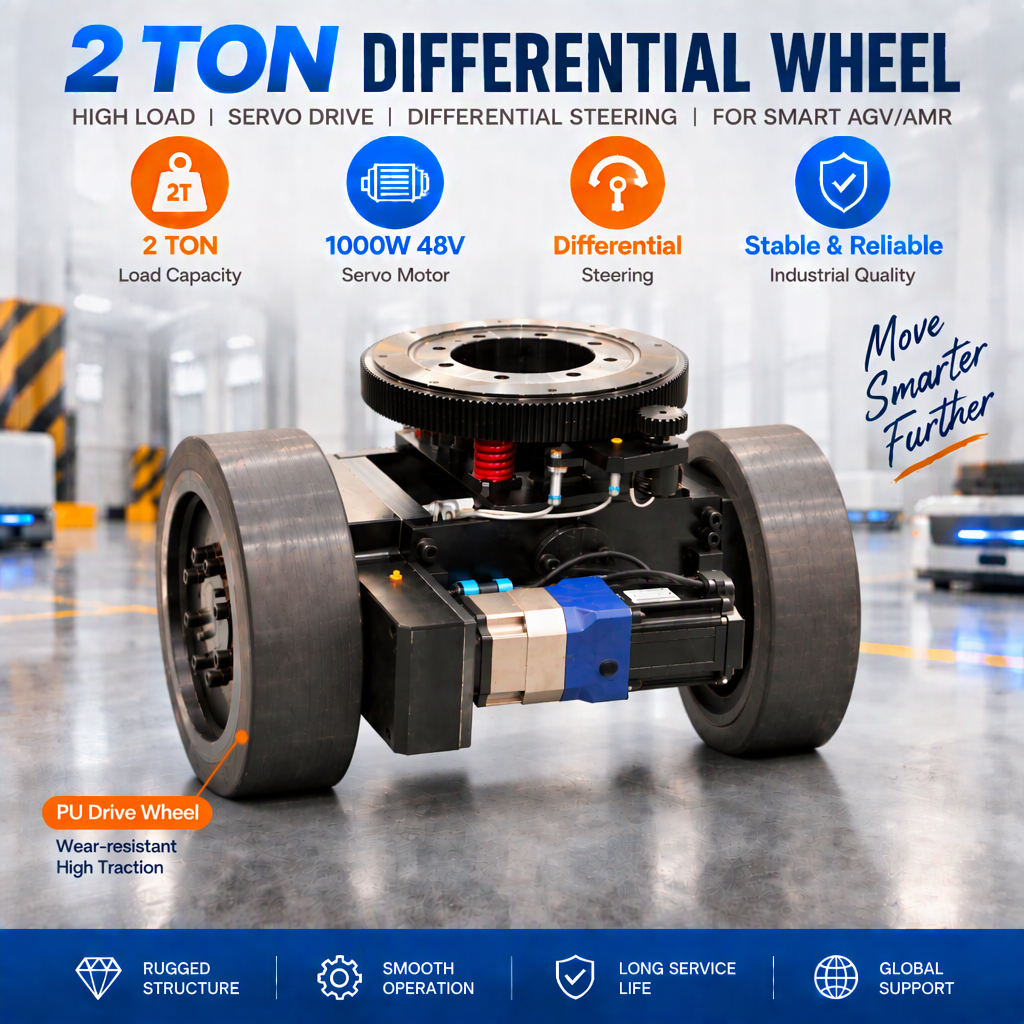
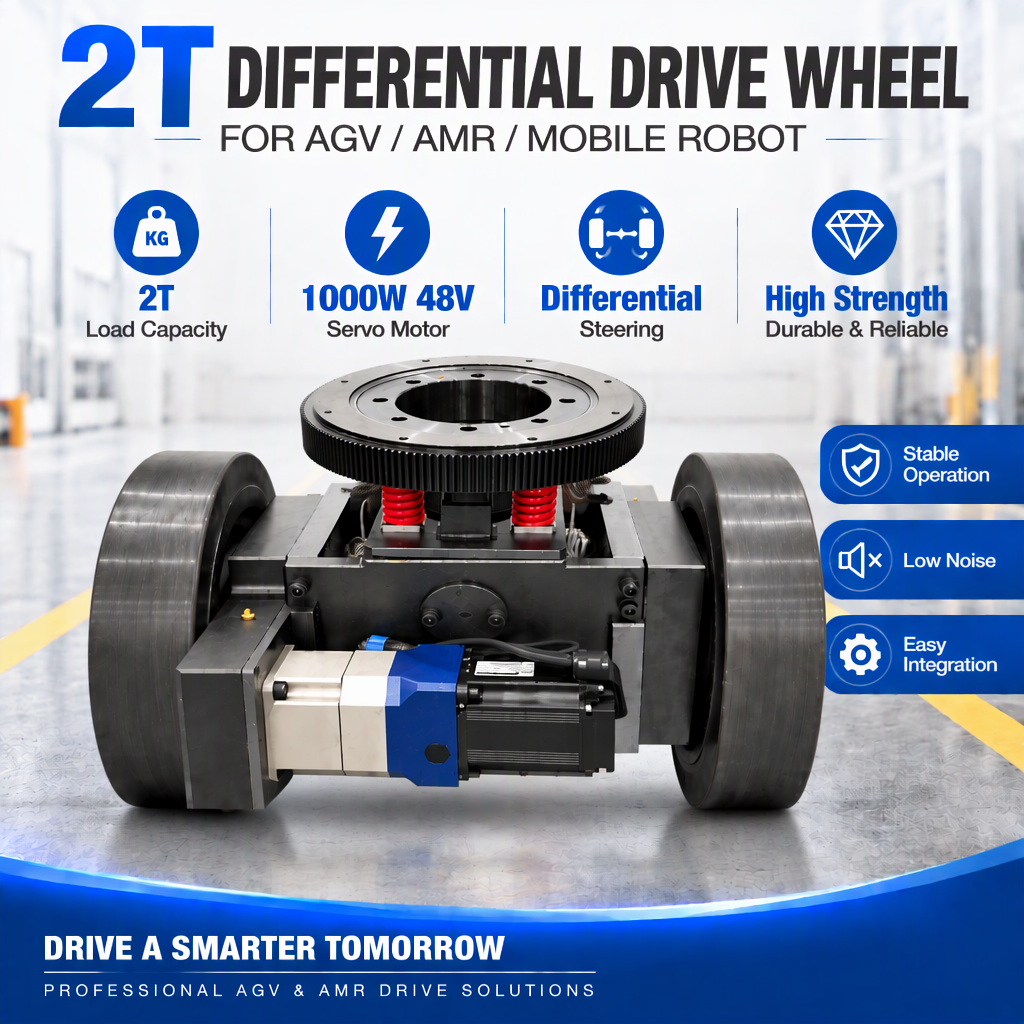
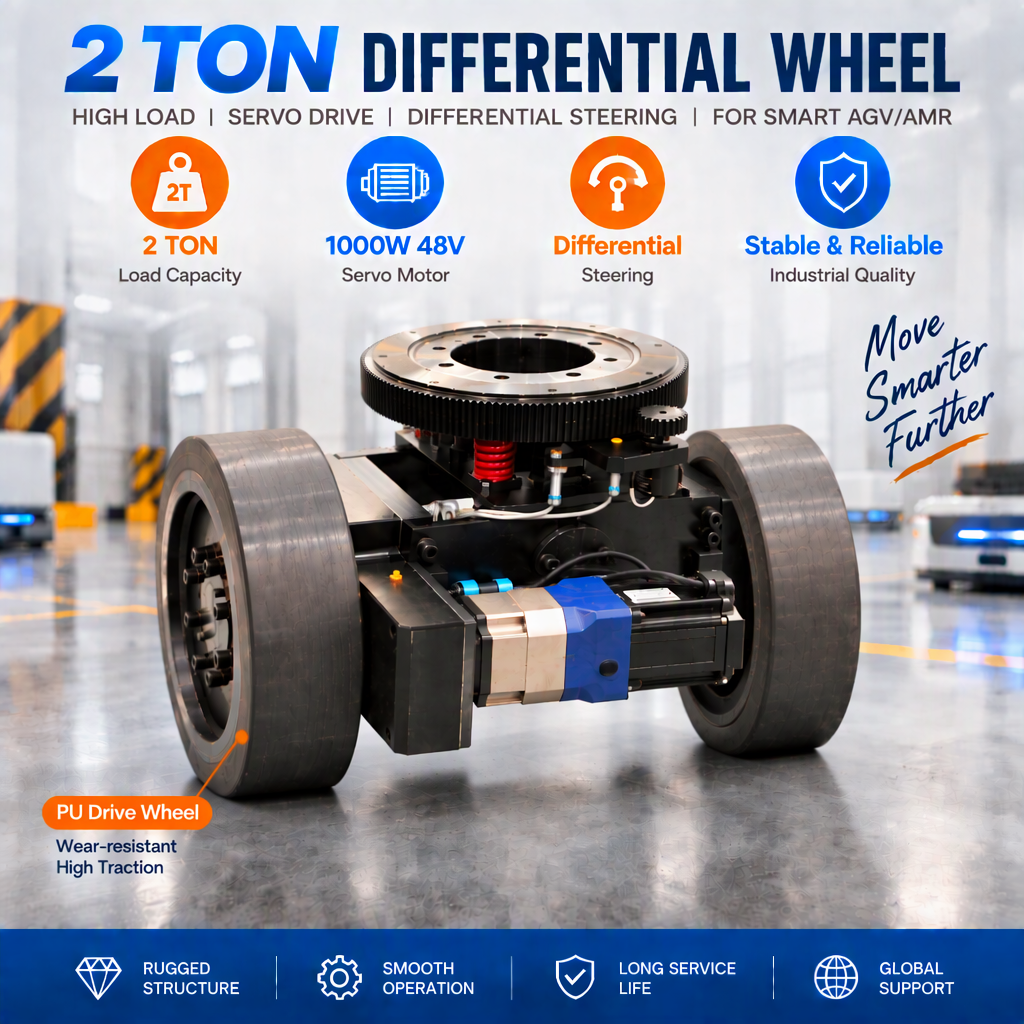
A customized 2000 kg-class differential drive wheel with suspension for mobile robots that need better floor contact and shock absorption. The 1000 W 48 V configuration suits heavy-duty warehouse platforms, towing tractors and production-line transfer vehicles.
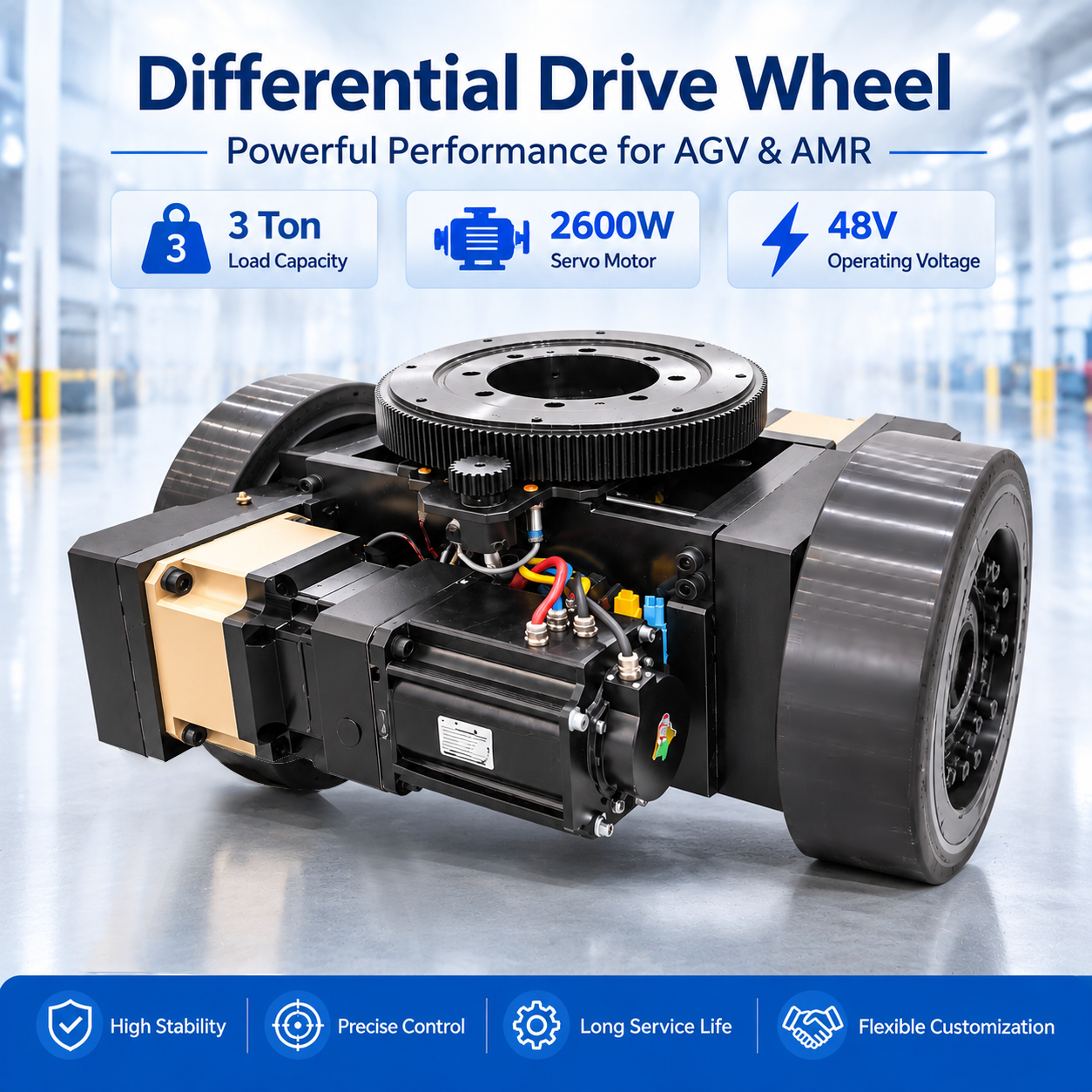
For high-payload AGV projects, this 3000 kg load capacity differential drive wheel pairs a 2600 W 48 V servo motor with customizable interfaces. It is aimed at automatic guided vehicles that need strong traction while preserving controlled acceleration and reliable stopping.
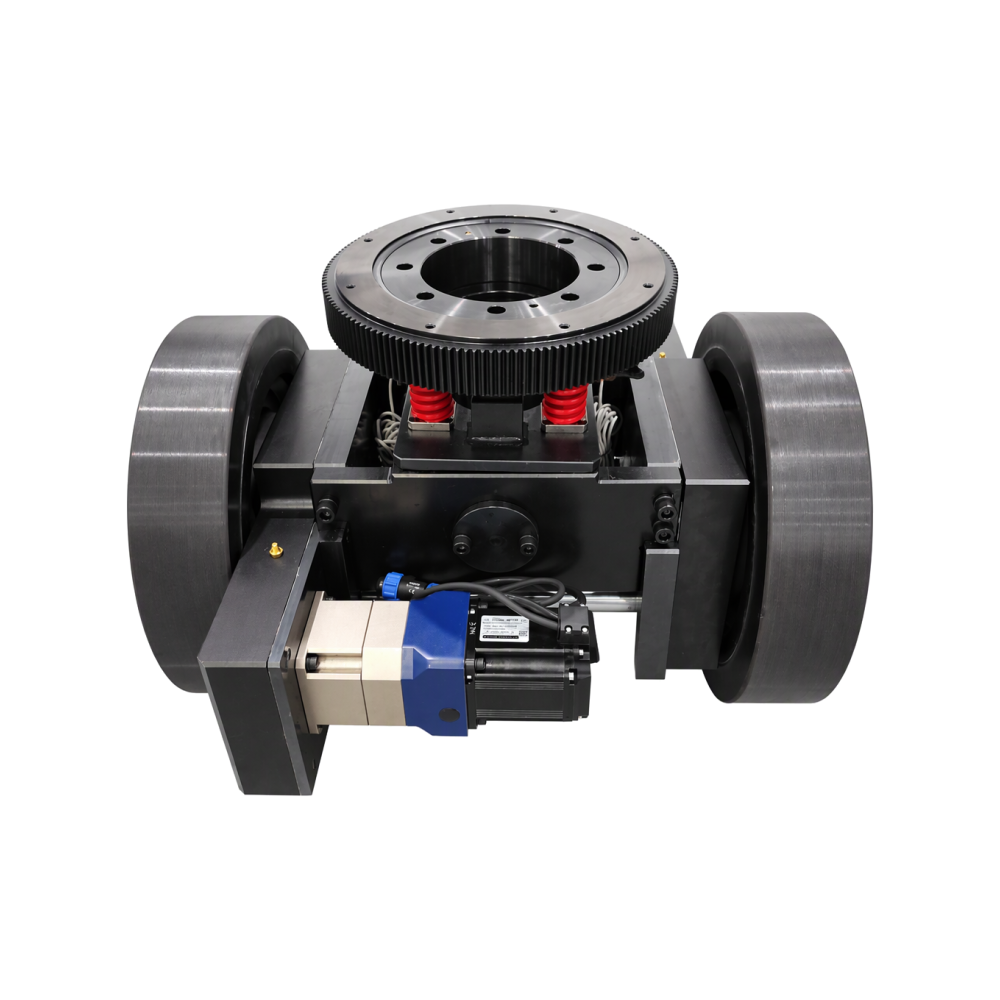
A heavy-duty series differential drive wheel with 1000 W 48 V servo motor control and spring suspension. It is suitable for logistics robots that operate on less-than-perfect floors and need repeatable differential steering, stable encoder feedback and replacement-friendly maintenance.
A 2000 kg traction capacity differential steering drive wheel for logistics robot builders that need controlled turning and a compact chassis footprint. It is typically evaluated for AMR towing, omnidirectional-style steering layouts and vehicles that must operate in narrow aisles.
This 2000 kg heavy-duty AGV wheel combines a 1000 W 48 V drive package with spring suspension and strong towing power. Buyers often compare it against the customized 2000 kg model when standardizing a fleet around a common 48 V battery architecture.
A 1000 kg heavy-duty capacity horizontal drive wheel assembly for material handling equipment and repair or upgrade projects. The assembly format helps shorten integration time when the chassis already defines a low deck height and a horizontal motor envelope.
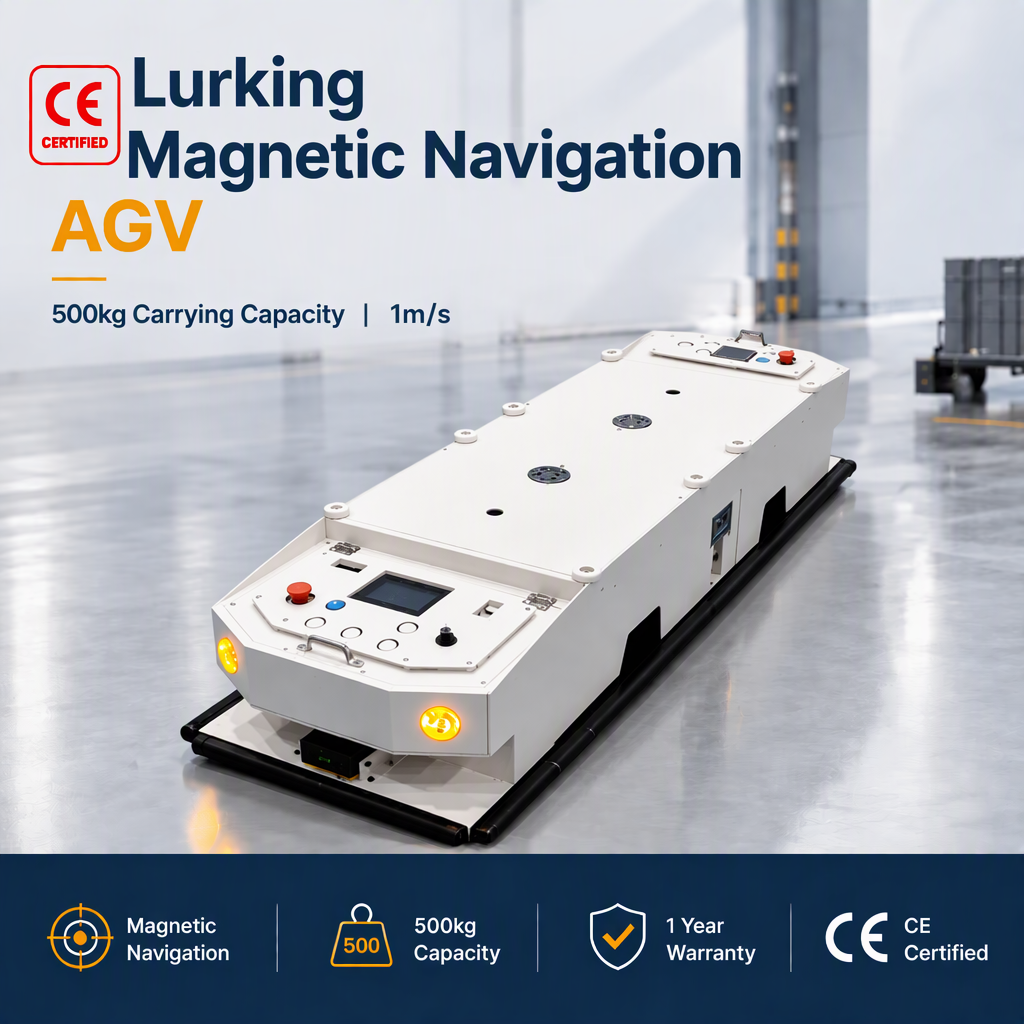
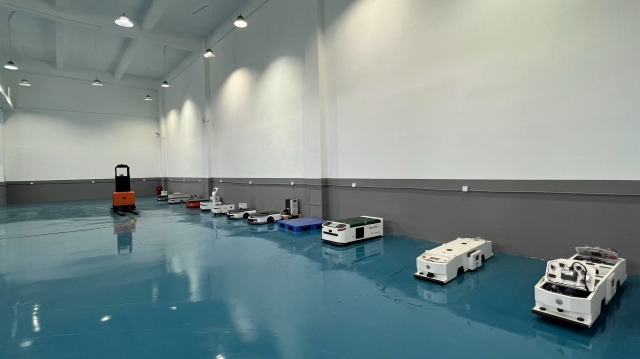
A complete 500 kg lurking AGV platform with EU CE positioning and bidirectional magnetic guidance for logistics automation. It is useful for buyers who want to benchmark a finished vehicle before specifying a custom fleet, or who need a compact trackless AGV for repetitive station-to-station movement.
What Buyers Really Mean When They Search for China Trackless AGV Factories
A search for “Top China Trackless AGV Factories & Wholesaler” can come from three very different buying situations. Matching the content to the actual intent shortens the evaluation cycle and prevents a low-price component quote from being compared with a complete vehicle project.
A trackless AGV is not defined by a single chassis style. It describes an automated guided vehicle that does not depend on fixed rails, trenches or floor chains. Navigation may rely on magnetic tape, RFID station tags, QR code grids, lidar SLAM or a hybrid of several methods. The drive wheel remains the mechanical heart of the system because it determines traction, turning behavior, floor contact, maintenance access and energy consumption.
China’s advantage in this category is not simply labor cost. The country has a dense ecosystem of motor, reducer, encoder, servo controller, wheel tread, sensor and sheet-metal suppliers. A mature factory can therefore match a horizontal drive wheel, a differential steering unit or a complete lurking AGV around a buyer’s payload, speed, gradient, battery voltage and available chassis height. The risk is that many online sellers describe themselves as factories without showing the manufacturing, testing and documentation evidence that serious wholesale buyers need.
For that reason, the best sourcing process treats the supplier as an engineering partner rather than a catalogue. Ask for the wheel drawing, motor curve, driver matching data, suspension travel, encoder type, braking option, IP protection target and mounting interface. Then verify how the supplier tests those values before shipment. This is where an ISO 9001:2015 certified manufacturer with in-house drive-train integration has a practical advantage over a trader assembling unrelated parts.
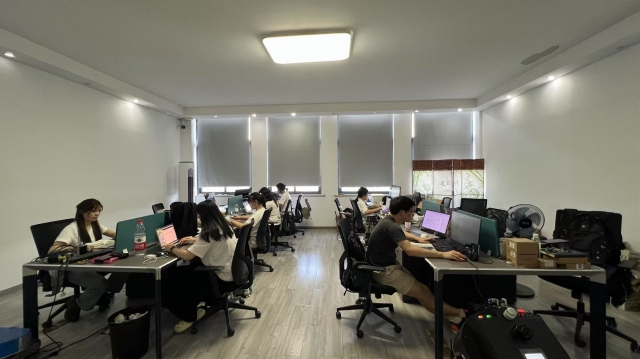
Factory-direct buyers should verify floor area, employee range, testing instruments, patents and onsite assessment evidence.
Wholesale and OEM buyers should ask for motor power, voltage, reduction ratio, wheel diameter, tread material and mounting customization.
Project buyers should confirm driver compatibility, sensor options, technical support, payment terms and delivery terms before a sample is built.
Factory evidence matters: production space, engineering staff and inspection capability should be verifiable before a wholesale order is placed.
Due-Diligence Framework
A Six-Part Checklist for Vetting a Trackless AGV Wholesaler
Use this checklist before comparing quotations. It is written for procurement engineers, robotics integrators and distributors who need repeatable supply rather than a one-off sample.
1. Verify the manufacturer identity
Confirm the legal entity, factory address, production area, employee range and whether the company is a manufacturer or a trading company. A clear company profile, onsite verification and product-category depth are stronger signals than a generic landing page.
2. Audit drive-train integration
Look for a supplier that can match wheel, motor, reducer, encoder, brake and controller. Misaligned components create commissioning delays, overheating and unstable low-speed motion.
3. Validate the duty cycle
Provide gross vehicle weight, target speed, maximum gradient, wheelbase, battery voltage and available chassis height. These five values determine the correct motor power, reduction ratio and wheel diameter.
4. Review quality evidence
Check ISO 9001:2015 certification, onsite verification, in-house testing instruments and prototype endurance runs. Ask how finished products are inspected and how production records are traced.
5. Confirm customization scope
Ask whether the factory supports sample-based customization, design-based customization, OEM production, buyer-label packaging and drawing-level changes to wheel diameter, tread, encoder and brake.
6. Stress-test commercial terms
Verify payment methods, currencies, delivery terms, packaging and after-sales routes before production. Flexible terms do not replace engineering evidence, but they reduce friction once the specification is approved.
Engineering Guide
Selection Matrix: Which Trackless AGV Drive Configuration Fits Your Project?
Use the matrix below as a first-pass filter. The final configuration should still be confirmed against your vehicle drawing, load distribution, control architecture and safety requirements.
Drive configuration
Typical catalogue example
Best-fit application
Data needed for quotation
Horizontal drive wheel assembly
1000 kg bearing capacity horizontal drive wheel; 1000 kg heavy-duty assembly
Low-clearance chassis, under-ride carts, compact material handling robots and retrofit projects
2000 kg traction capacity AGV/AMR differential steering drive wheel
Narrow-aisle AMR, tricycle-style vehicles and robots that require controlled steering angles
Turning radius, steering motor voltage, encoder protocol, maximum steering torque
Complete trackless AGV platform
500 kg EU CE lurking AGV with bidirectional magnetic guidance
Station-to-station logistics automation, pilot fleets and benchmark projects before custom vehicle development
Route length, number of stations, floor tape layout, throughput target, safety and CE scope
Information-gain note: do not choose a drive wheel by payload alone. The same 2000 kg vehicle can require very different torque if it must climb a ramp, stop within a short distance or carry an offset load. Send the load diagram and duty cycle, not only the total weight.
A practical wholesale sourcing scorecard
The percentages below are a recommended evaluation framework for buyers comparing multiple China trackless AGV factories. Adjust them for your own risk profile, but keep engineering fit ahead of unit price.
Drive-train integration
30%
Quality verification
25%
Customization depth
20%
Export and post-sale support
15%
Total cost and energy
10%
Quick quotation checklist
Vehicle typeLurking, jacking, towing, forklift or AMR
The buying conversation is moving from “Can you supply a wheel?” to “Can you supply a validated drive-train module that shortens our engineering cycle?” This shift favors factories with test data, matched electronics and documentation.
Single-source drive trains
Procurement teams increasingly prefer one supplier for wheel, motor, reducer, encoder, brake and controller. It reduces compatibility risk and makes warranty responsibility clearer.
Total cost of ownership
Buyers are comparing energy efficiency, tire wear, bearing life, spare-part availability and commissioning time instead of judging only the initial unit price.
Evidence-based compliance
CE-oriented projects, safety reviews and factory audits require traceable claims. Suppliers that can show ISO certification, onsite verification and product testing evidence are easier to approve.
Modular customization
Wholesale buyers want configurable modules rather than fully bespoke vehicles. Standard mounting patterns, selectable voltages and documented parameter files accelerate repeat orders.
Product Development Trends
Where Trackless AGV Drive Technology Is Heading Next
These development themes help wholesale buyers anticipate which platforms will remain serviceable and competitive over a multi-year fleet plan.
Higher payload density
Drive wheels are being engineered to carry more load in a smaller envelope. This supports lower vehicle decks, denser warehouse layouts and more compact chassis designs.
Low-profile horizontal drives
Horizontal drive wheel assemblies are becoming more important for under-ride carts and low-clearance platforms where a vertical motor stack cannot fit.
Integrated servo / BLDC control
Drivers are increasingly tuned to specific wheel-motor combinations. Matched servo or BLDC controllers simplify wiring, parameter setup and fault diagnosis during commissioning.
Sensor fusion and hybrid navigation
Magnetic guidance remains cost-effective, while RFID, QR codes, lidar and SLAM add flexibility. Hybrid systems help vehicles move between fixed routes and dynamic open areas.
Digital documentation
CAD files, wiring diagrams, controller parameter files and maintenance schedules are becoming part of the deliverable. They reduce integration risk and support after-sales service.
Energy and maintenance efficiency
Battery voltage standardization, lower rolling resistance, sealed bearings and serviceable treads are being evaluated as lifecycle cost drivers, not secondary details.
Company Advantage
Why Zhejiang Torqen Technology Is a Practical Wholesale Partner
A credible trackless AGV factory should be able to explain not only what it sells, but how the drive train is matched, tested and supported after delivery. Torqen’s public company profile provides the operational details that engineering buyers usually request.
Founded in 2015 in Zhejiang, China, Zhejiang Torqen Technology Co., Ltd. designs and manufactures automatic guided vehicles, AGV drive wheel assemblies, DC/AC motors, encoders, reducers, motor controllers, caster and PU wheels, and in-wheel motor units. The company operates as both a manufacturer and trading company, with a team reported at 51–100 people, a factory area of 1,000–3,000 m² and annual output in the US$5 million–10 million range.
The practical value for a trackless AGV wholesaler is breadth with matching depth. Drive wheels, servo and BLDC controllers, magnetic guide sensors, RFID position sensors and lidar sensors can be sourced through one engineering conversation. That reduces the risk of buying a wheel that fits the drawing but not the driver, or a sensor that works in the demonstration video but not on the buyer’s route.
Quality evidence includes ISO 9001:2015 certification, an onsite-verified facility assessment by Intertek, eight awarded patents, five in-house testing instruments and extended-duration prototype testing before production release. Buyers also have access to company profile, trade capacity, transaction history and feedback sections for further due diligence.
OEM and ODM support for motor power, voltage, reduction ratio, wheel diameter, tread material, encoder type, brake options and mounting interfaces.
Export-ready payment and delivery options, including T/T, L/C, D/P, D/A, PayPal and other methods in multiple currencies.
Engineering support for integration, wiring diagrams, controller parameter files and after-sales fault analysis.
Testing and inspection support finished-product checks.
2015Founded in Zhejiang
10+Years in drive technology
8Patents awarded
51–100Team and engineer range
4.9/5Buyer rating
97.9%Inquiry response rate
Applications
Industries That Use Trackless AGV Drive Hardware
The same drive and control building blocks appear across mobile equipment platforms. This matters for wholesale buyers because proven components can be adapted across multiple product lines.
AGV & AMR
Forklifts
Aerial platforms
Airport equipment
Agricultural machines
Hydraulic systems
Floor scrubbers
Wind energy
Marine equipment
Medical devices
Purchasing FAQ
Trackless AGV Factory and Wholesale Questions Buyers Ask
The answers below reflect common procurement questions about customization, quality verification, drive selection and international trade terms.
What is a trackless AGV, and how is it different from a traditional guided vehicle?
A trackless AGV does not rely on fixed floor rails or chains. It may follow magnetic tape, read RFID tags or QR codes, or use lidar SLAM and natural-feature navigation. The drive wheel and controller still determine motion quality, but the route can be changed by updating the floor markers or navigation map rather than rebuilding fixed infrastructure.
Which drive wheel type should I choose for a new trackless AGV platform?
Choose a horizontal drive wheel assembly when chassis height is the limiting factor. Choose a differential drive wheel with suspension when the vehicle needs stable traction on less-than-perfect floors. Choose a differential steering drive wheel when controlled steering angles and narrow-aisle maneuverability matter. For a complete vehicle benchmark, a lurking AGV with magnetic guidance can be a faster way to validate a route before custom development.
Does Torqen support OEM and ODM customization for AGV components?
Yes. The published customization scope includes sample-based customization, design-based customization, OEM production, design services and buyer-label packaging. Typical change points include motor power and voltage, reduction ratio, wheel diameter and tread material, encoder type, brake options and mounting interfaces. Buyers should provide a chassis drawing and duty cycle so the customization can be checked against torque and thermal limits.
How is product quality verified before shipment?
Torqen reports ISO 9001:2015 quality management certification and an onsite-verified facility assessment by Intertek. Production quality control includes finished-product inspection with five in-house testing instruments, and prototypes undergo extended-duration testing before production parts are released. For high-volume projects, request the inspection plan, test records and traceability requirements in the purchase order.
What payment and delivery terms are available for wholesale orders?
Accepted payment methods include T/T, L/C, D/P, D/A, MoneyGram, credit card, PayPal, Western Union, cash and escrow, in USD, EUR, JPY, CAD, AUD, HKD, GBP or CNY. Delivery terms include FOB, CFR, CIF, EXW, CIP, FCA, CPT, DDU and express delivery. Final terms depend on product type, order volume, destination and the agreed inspection plan.
Which industries use these drive wheels, controllers and sensors?
Typical applications include AGVs and AMRs, forklifts, aerial work platforms, airport equipment, agricultural machines, hydraulic applications, floor scrubbers and sweepers, wind energy, marine equipment and medical devices. The common requirement is controlled electric motion in a compact, serviceable package.
How can I get a faster wholesale quotation?
Send the vehicle type, gross load, target speed, maximum gradient, battery voltage, available chassis height, wheel diameter limit, navigation method and required quantity. If you already have a drawing, share it with the inquiry. These details let the engineering team recommend a drive wheel, motor, reducer, controller and sensor combination instead of quoting a generic part.
Request a Trackless AGV Drive Solution Built Around Your Chassis
Share your load, speed, voltage, floor condition and navigation plan. The engineering team can match a horizontal drive wheel, differential drive assembly, steering unit, servo controller or complete AGV platform for your wholesale or OEM project.