Eight Factory-Matched Components for Memphis Transport Robot Builds
Industrial transport robot projects in Memphis rarely fail because one part is weak. They fail when the drive wheel, controller, encoder, brake and navigation sensor are sourced as unrelated parts. The eight components below are built to be matched at the interface level, so a Memphis integrator can move from specification to a working AGV or AMR pilot faster.
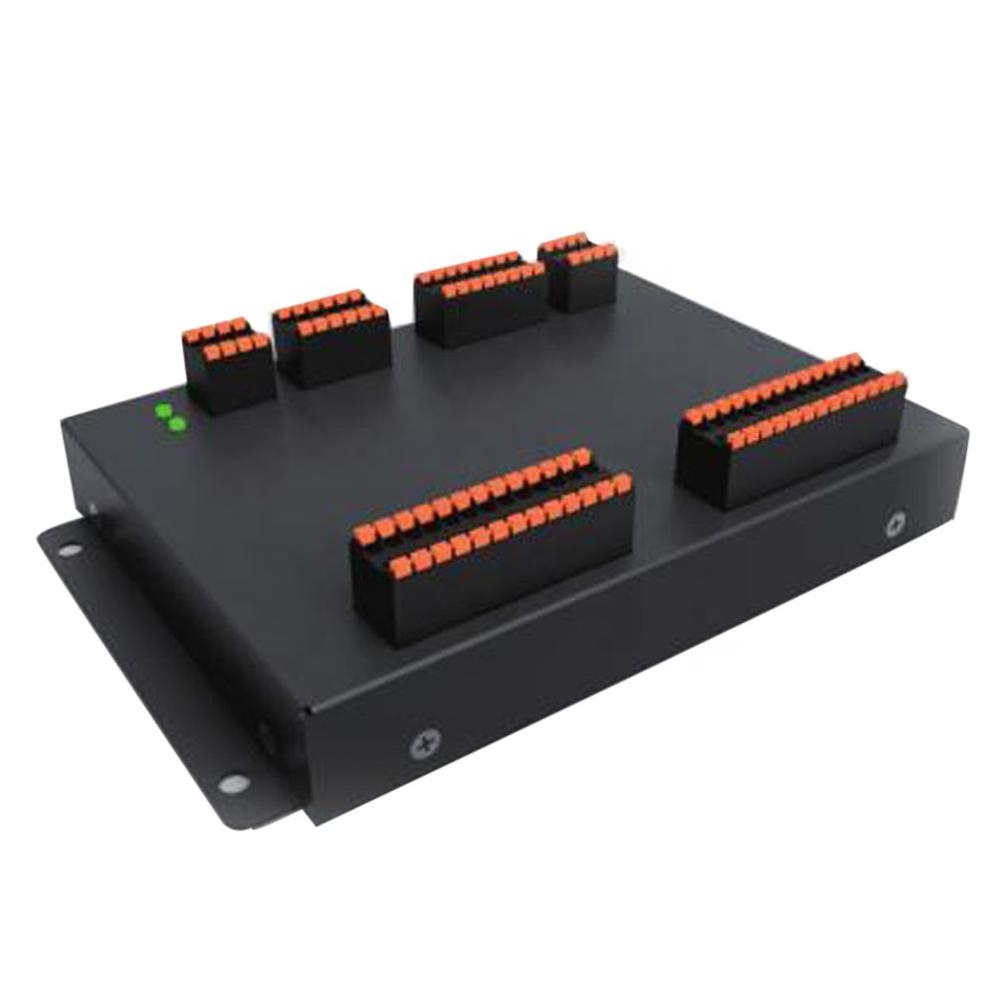
TZBOT TZC-MST-FX200D-A Controller for Commanding the AGV
Command-level controller for task sequencing, I/O coordination and route logic — useful where Memphis cross-dock robots hand off between conveyor, lift and traffic-control zones.
- AGV control
- Task dispatch
- Integration-ready
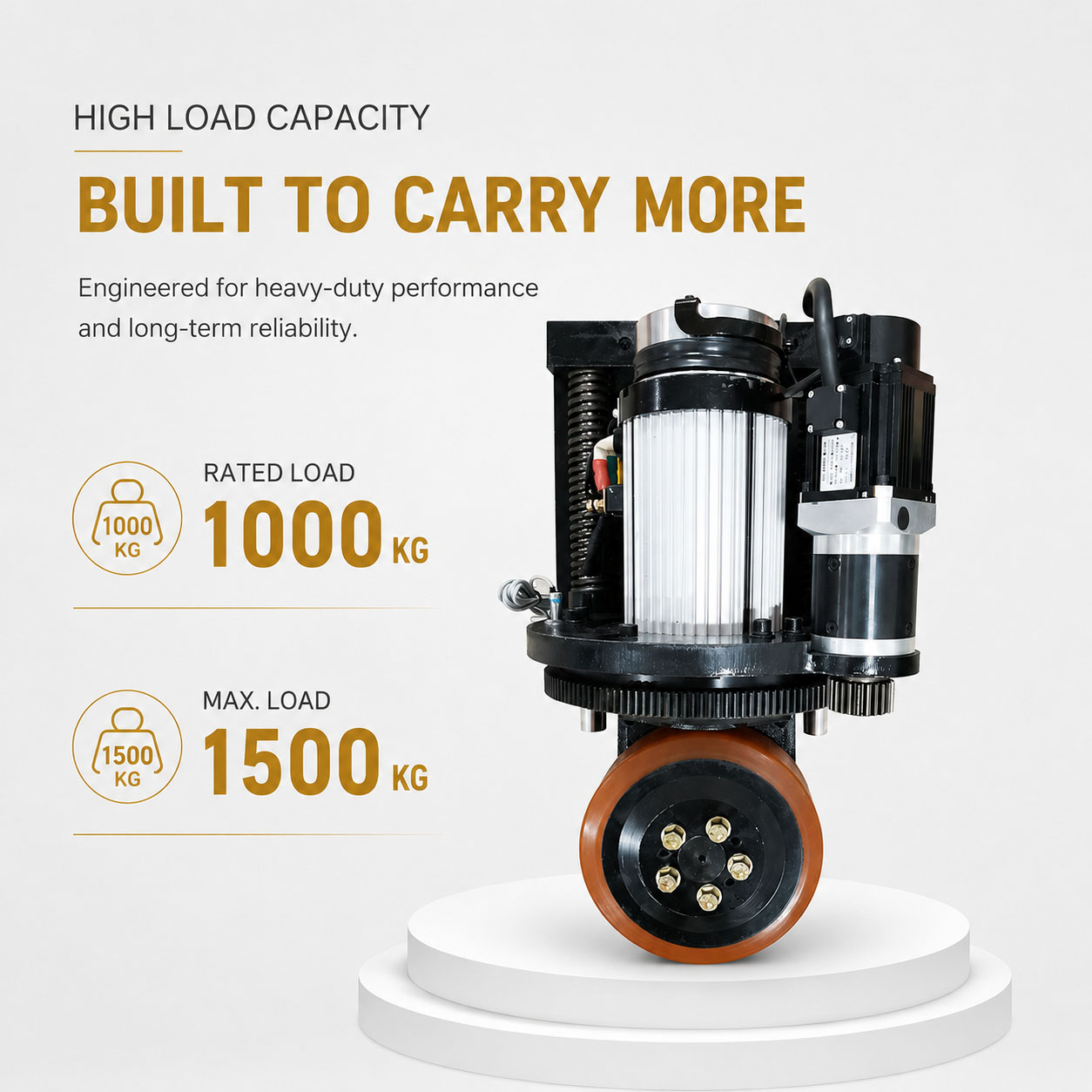
TZBOT 1000KG Bearing Duty 1500w Servo Motor AGV Forklift Driving Wheel with Suspension for Automatic Forklift
Suspension helps absorb dock-level transitions, expansion joints and floor seams; the 1000 kg bearing duty class suits automatic forklifts and tugger platforms.
- 1500 W servo
- Suspension
- Forklift AGV
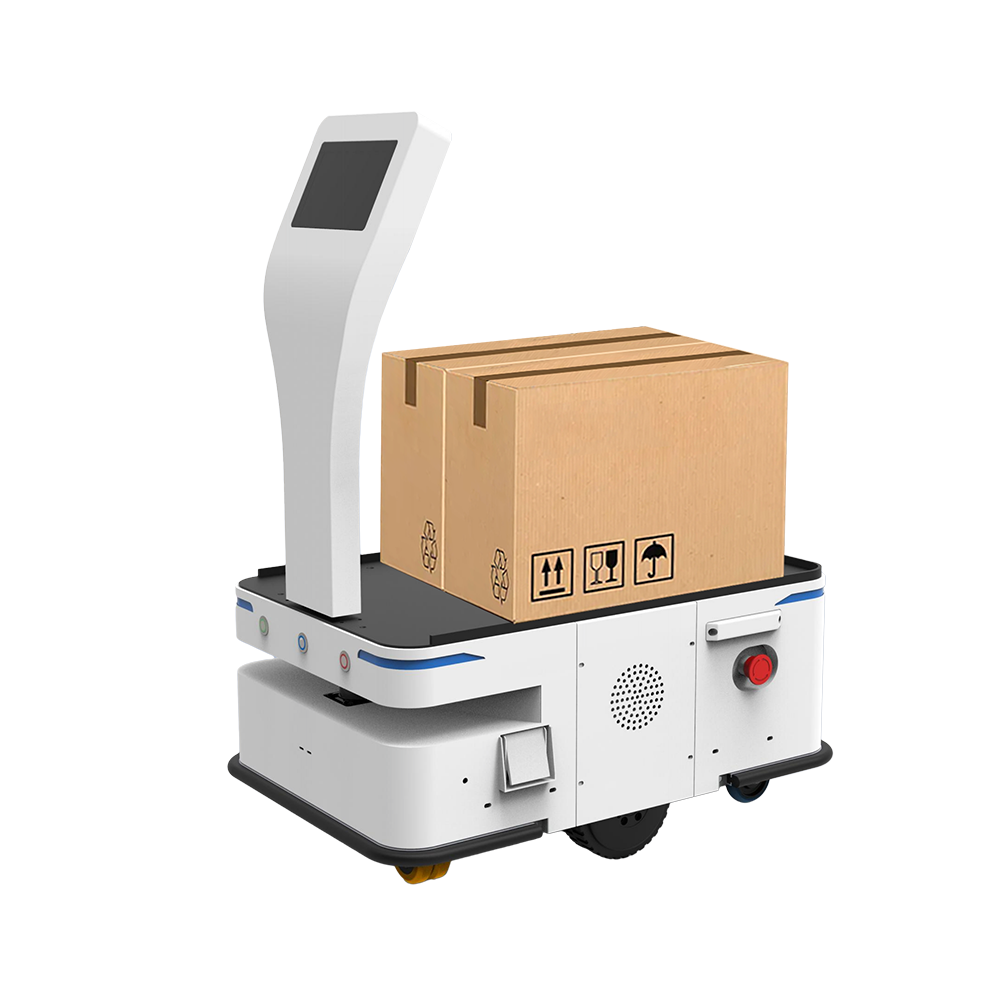
TZBOT High Precision Guidance Laser Slam Navigation Amr Robot 80kg Carrying Capacity Material Handling Amr Robot with 7 Inch HMI
Natural-feature navigation reduces fixed floor infrastructure, making this 80 kg AMR useful for flexible pilot zones, engineering labs and mixed-layout production floors.
- Laser SLAM
- 80 kg payload
- 7-inch HMI
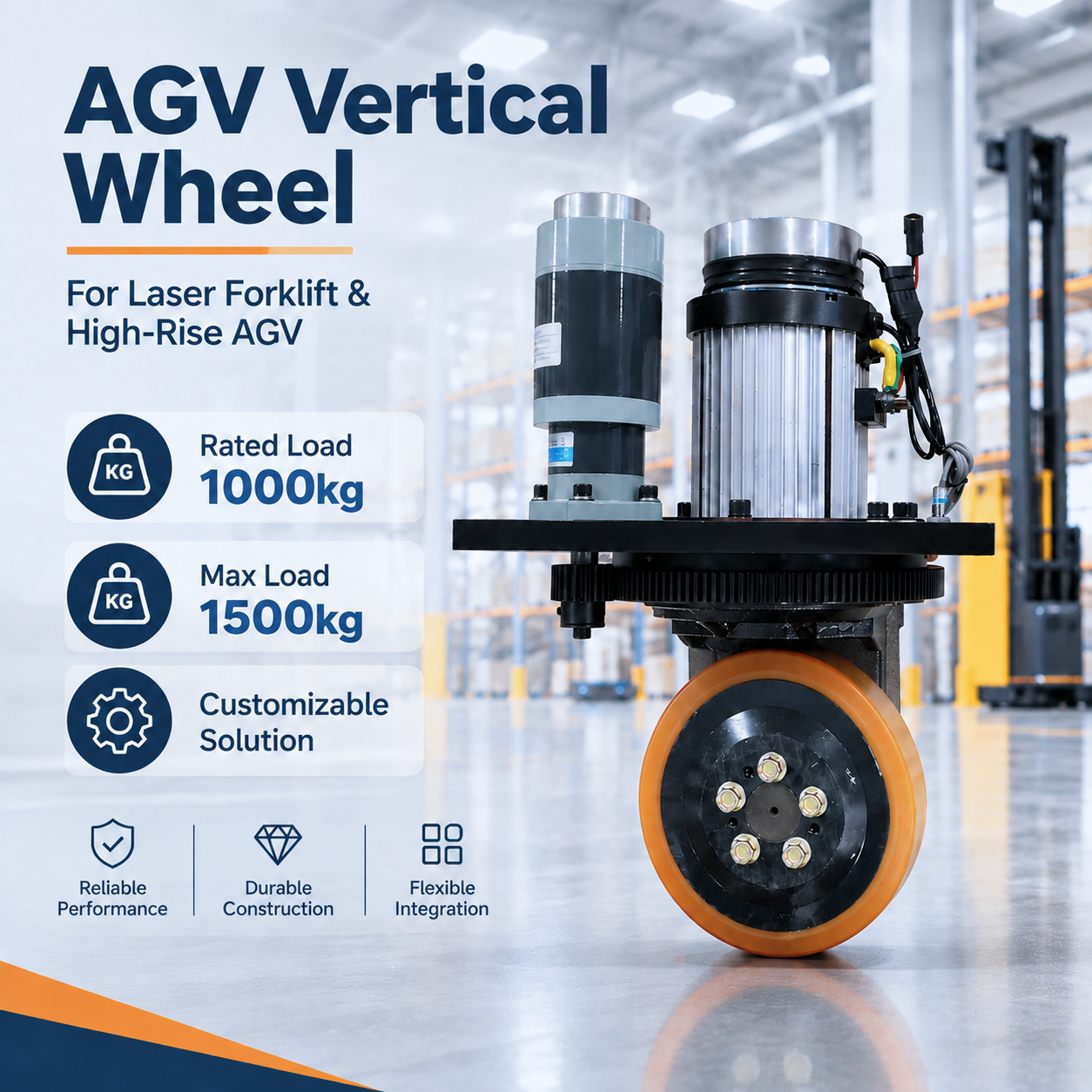
TZBOT 2590r/min Vertical Driving Unit Electric Traction Wheel 1500W Steering Forklift Accessories
Vertical traction and steering layout for forklift-type and tricycle AGV chassis that need controlled steering angles at dock approaches and aisle junctions.
- 1500 W
- 2590 r/min
- Steering drive

TZBOT 48V DC 2 Ton Heavy Duty Differential Unit AGV Wheel TZCS-750-30
Heavy-duty 48 V DC differential unit for 2-ton-class logistics robots, with the torque reserve needed for repeated starts, stops and ramp approaches.
- 2 ton class
- 48 V DC
- Differential unit
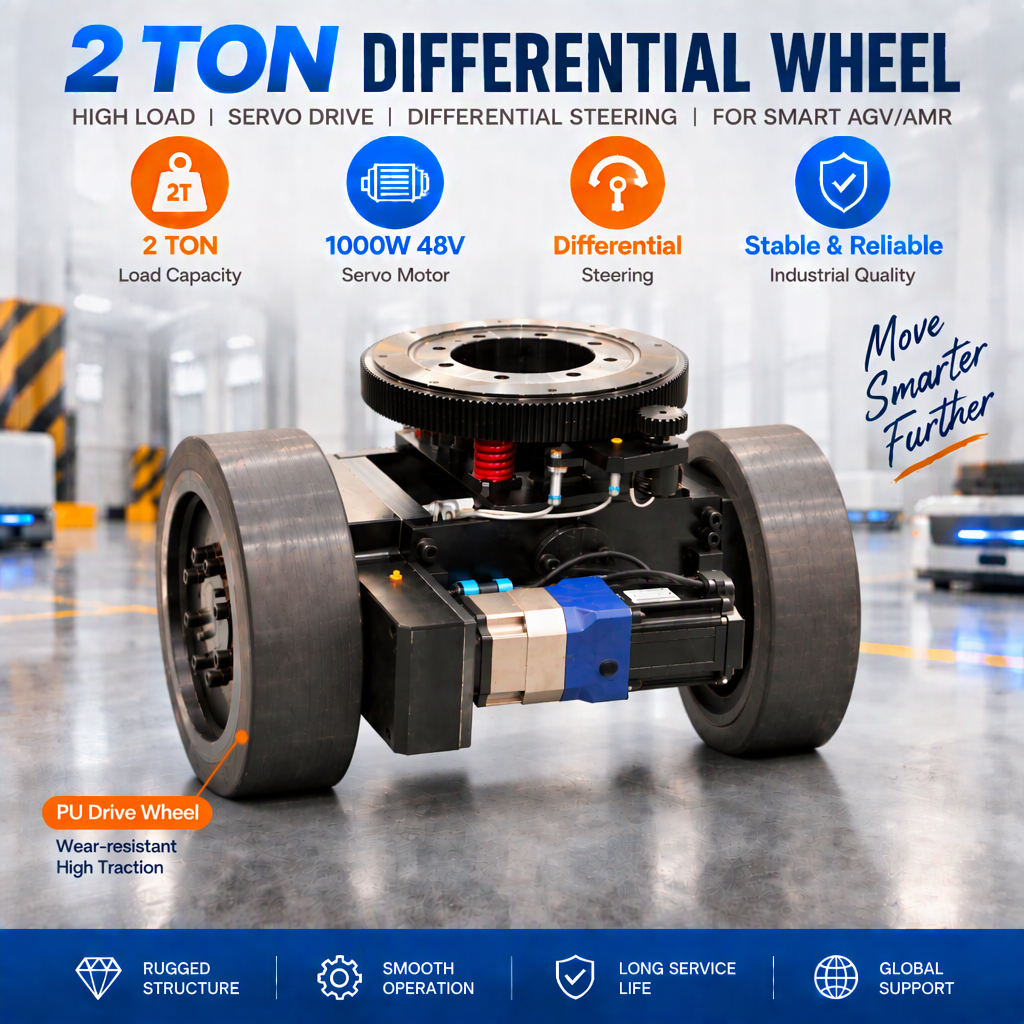
TZBOT Customized 2000kg Bearing Duty agv Wheel 1000w 48V Heavy Duty Series Mobile Robot Differential Drive Wheel with Suspension
Customizable 2000 kg bearing-duty differential wheel with suspension for mobile robots that encounter floor transitions, trailer ramps and uneven dock plates.
- 2000 kg
- 1000 W / 48 V
- Suspension
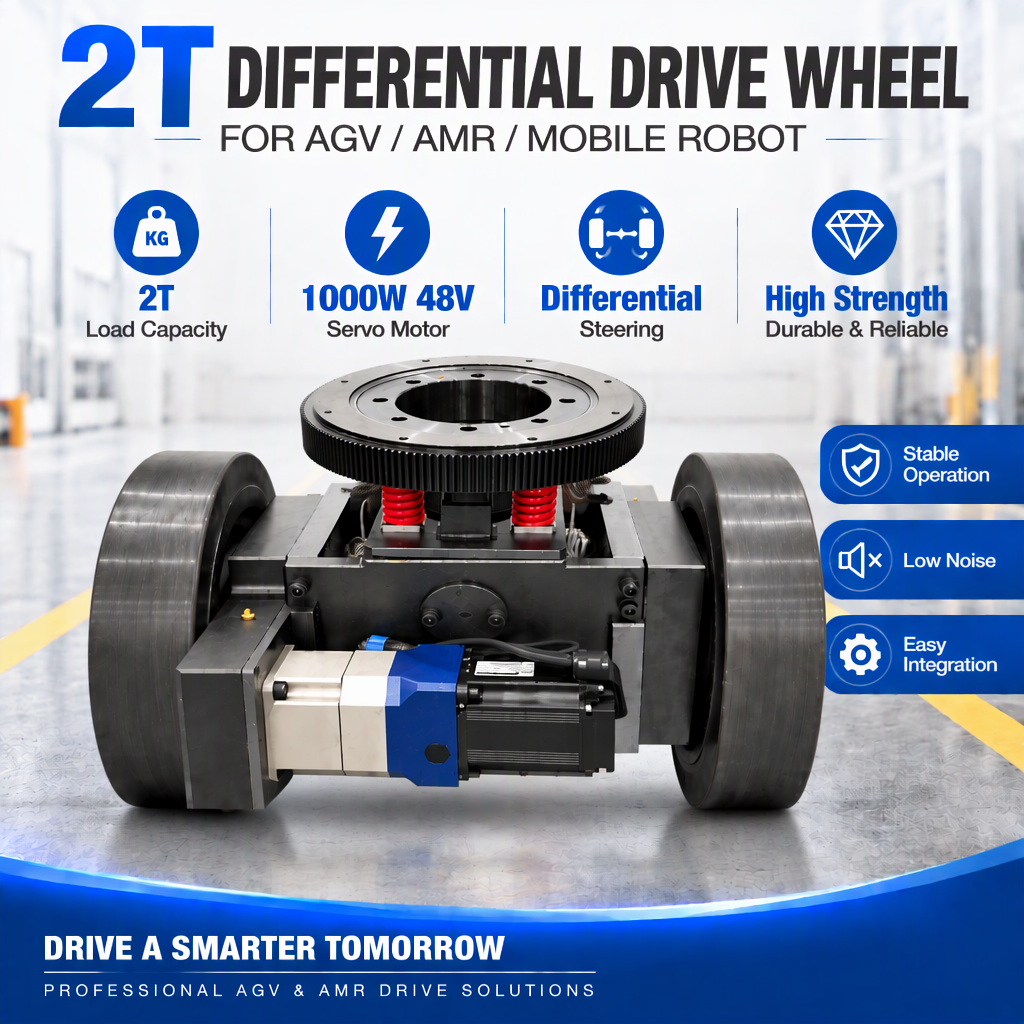
TZBOT 2000kg Traction Capacity Logistic Robot Part agv Amr Differential Steering Drive Wheel for Sale
Differential steering drive wheel for logistics robots that need both traction and controlled directional changes in dense storage and cross-dock traffic.
- 2000 kg traction
- Differential steering
- Logistics robot
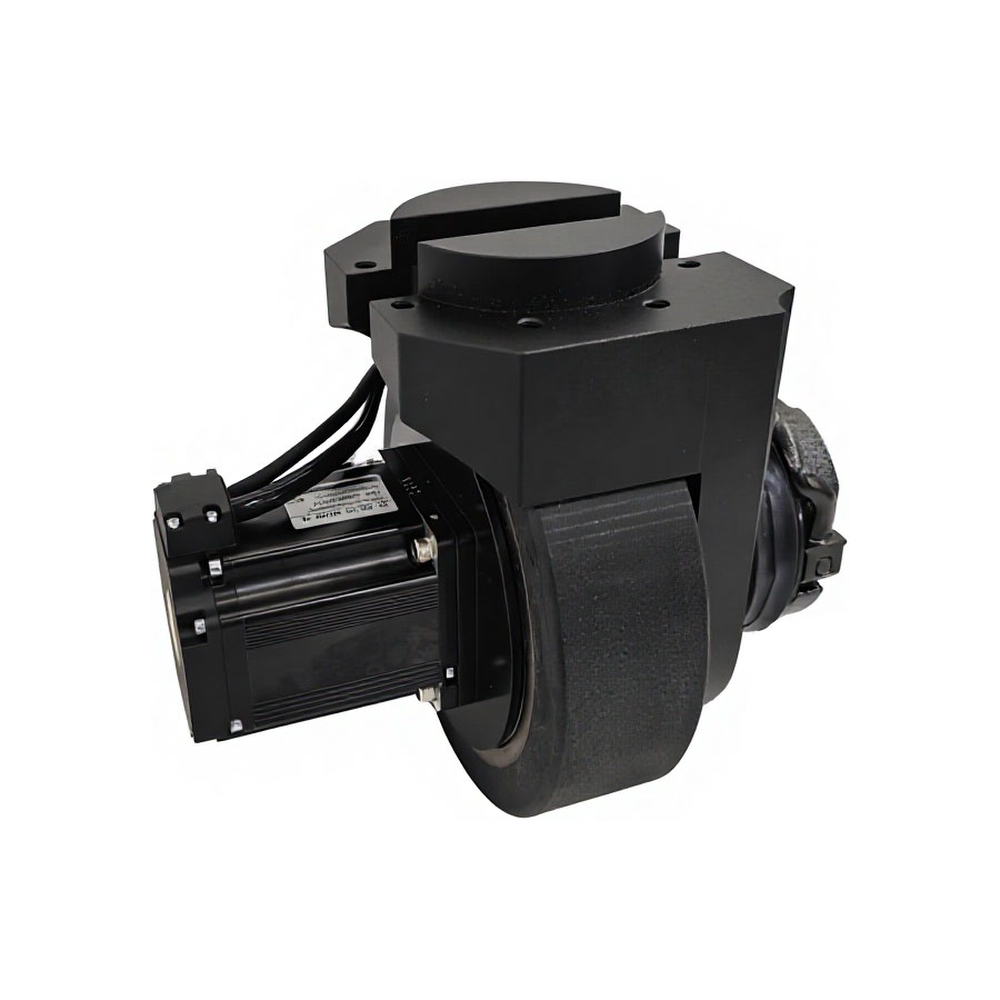
TZBOT 1000kg Bearing Capacity agv Wheel 1000w Servo Motor Material Handling Equipment Part Horizontal Drive Wheel
Horizontal drive wheel assembly for lower chassis height and compact under-ride carts, with 1000 W servo power for material handling platforms.
- 1000 kg
- 1000 W servo
- Low clearance
Why Industrial Transport Robots in Memphis Need a Different Engineering Standard
Memphis, Tennessee is not a generic warehouse market. It is a freight gateway where distribution, air cargo, rail, trucking, cold chain and advanced manufacturing meet. That mix changes what a transport robot must endure.
A Memphis facility may move product from a sealed smooth production floor to an expansion joint, a dock leveler, a trailer floor, a high-throughput cross-dock lane and a cold room within one shift. A transport robot that performs well in a clean lab may hesitate at a trailer threshold, lose traction on condensation, or create traffic bottlenecks when the floor layout changes. That is an engineering problem, not only a software problem.
The practical implication is simple: Memphis buyers should specify the drive wheel, motor, controller and navigation architecture as one system. Payload alone is not enough. You also need to define wheel load, duty cycle, floor friction, ramp grade, deceleration, safety response and the amount of fixed infrastructure the site will tolerate. A 2-ton differential unit selected only by tonnage may deliver the wrong acceleration profile; a low-cost drive wheel without suspension may transfer every floor seam into the chassis.
For local buyers searching for an industrial transport robot manufacturer and factory in Memphis, the most useful supplier is not the one with the largest catalog. It is the one that can explain why a heavy-duty differential unit, a steering drive wheel, a servo controller and a laser SLAM AMR should or should not be combined for a specific Memphis application. That is the standard this page applies.
Payload and load center
Gross vehicle weight, load center and axle distribution determine wheel load. A 1,000 kg or 2,000 kg rating must be matched to the actual duty point, not only the catalog headline.
Floor profile and dock transitions
Dock plates, floor joints, thresholds and wash-down areas affect traction and shock. Suspension and wheel tread should be reviewed before a pilot begins.
Duty cycle and charging
Multi-shift Memphis operations need repeatable starts, stops and acceleration. Battery voltage, controller current and charging windows should be planned together.
Navigation and traffic
Magnetic guide, RFID stations, QR grids and laser SLAM solve different problems. The right choice depends on layout change frequency and infrastructure tolerance.
Safety and interoperability
Emergency stop behavior, obstacle sensing, speed zones, bumper logic and traffic rules affect controller selection and machine integration.
Serviceability and spares
A Memphis maintenance team needs predictable replacement parts, traceable production records and clear wiring or parameter documentation.
Recommended Configurations by Memphis Application
The same AMR platform can require a completely different drive unit depending on how it steers, how low the chassis must sit and how often it meets a dock plate.
Use this matrix as an early-stage filter, not as a substitute for engineering review. The strongest specification starts with the jobs the robot must perform, then works back to wheel load, torque, speed, suspension, voltage and control architecture.
| Memphis Use Case | Recommended TZBOT Components | Why This Combination Works |
|---|---|---|
| High-throughput cross-docking and trailer loading | 2000kg Traction Capacity Differential Steering Drive Wheel; 48V DC 2 Ton Heavy Duty Differential Unit; FX200D Controller | Differential steering supports tight lateral transfers and controlled dock approaches. Heavy-duty differential units provide torque reserve for repeated starts with a loaded pallet. Suspension should be reviewed if dock plates and trailer transitions vary. |
| Automatic forklift and tugger projects | 2590r/min Vertical Driving Unit 1500W; 1000KG Bearing Duty 1500W Suspension Wheel; FX200D Controller | A steering drive unit gives controlled wheel angle for forklift-type and tricycle chassis. Suspension helps protect the load and chassis when the robot crosses joints, ramps and dock levelers. |
| Flexible AMR pilots with limited fixed infrastructure | High Precision Laser SLAM 80kg AMR; Horizontal 1000kg Servo Drive Wheel; matched servo/BLDC driver | Laser SLAM reduces dependence on magnetic tape or QR grids. A horizontal drive assembly keeps chassis height compact when the robot must slide under carts or integrate into lower mobile platforms. |
| Low-clearance under-ride carts | 1000kg Horizontal Drive Wheel 1000W; 1000KG Suspension Drive Wheel; servo controller | Horizontal mounting solves height constraints. Suspension can be added where floor transitions create shock. The controller must be tuned to the wheel diameter, gear ratio and expected acceleration. |
| Heavy 2-ton logistics robots | 48V DC 2 Ton Heavy Duty Differential Wheel TZCS-750-30; Customized 2000kg Suspension Differential Wheel; 2000kg Traction Steering Wheel | At 2-ton class, small differences in floor slope, tire contact and braking profile become significant. Engineers should confirm traction, reducer ratio and current limits before ordering. |
Where These Transport Robot Components Fit in Memphis Facilities
Memphis operations are diverse, but the engineering questions repeat: how heavy, how often, how tight, how clean, how safe and how fast to deploy.
Memphis Material Handling Trends Shaping 2025–2030
Local buyers are not only looking for a lower-cost component. They are looking for a transport robot system that protects uptime, safety and deployment speed as labor and facility constraints change.
Labor resilience and multi-shift stability
Memphis distribution operations face recurring pressure to stabilize repetitive moves across shifts. Transport robots are increasingly evaluated not as demonstrations, but as production assets with predictable cycle times, maintenance intervals and spare-part availability.
Denser layouts and micro-fulfillment
As urban fulfillment and same-day service expectations rise, Memphis facilities are testing narrower aisles, smaller buffer zones and more frequent reconfiguration. Differential steering, low-clearance horizontal drive wheels and laser SLAM navigation become more valuable when space is tight.
Cold-chain scrutiny and food safety
Food and beverage distribution in the Memphis region places a premium on reliable movement, cleanable equipment surfaces and stable performance in temperature-controlled areas. Drive components, controllers and sensors should be reviewed for condensation, wash-down proximity and maintenance access.
Safety and traffic interoperability
Robots increasingly share aisles with forklifts, pedestrians, pallet jacks and conveyors. The controller and sensor stack must support speed zones, obstacle avoidance, emergency-stop logic and clear handoff behavior at intersections and dock doors.
Factory-direct procurement with integration support
Memphis buyers increasingly compare factory-direct component suppliers against local distributors. The winning supplier provides clear drawings, matched electronics, export terms, traceable testing and fast technical answers — not only a price list.
Electrification and battery-aware control
As more mobile equipment moves to electric drive, battery voltage, current limits, regenerative behavior and charger interfaces must be matched to the drive wheel and controller. A 48 V platform with the wrong current limit can underperform even with a correctly sized wheel.
Factory-Direct Engineering for Memphis Automation Builders
Zhejiang Torqen Technology Co., Ltd. has manufactured AGV drive systems, motors, controllers and sensors since 2015. Memphis buyers benefit from a component source that can match the drivetrain before shipment, then support the integration after delivery.
One supplier for the complete motion path
Torqen designs and manufactures automatic guided vehicles, AGV drive wheel assemblies, DC/AC motors, encoders, reducers, servo and BLDC motor controllers, navigation sensors, caster and PU wheels, and in-wheel motor units. Buying drive wheels, motors, drivers and sensors from separate vendors creates integration risk. Torqen matches them in-house so the robot chassis has a clearer path to first movement.
The company operates as a manufacturer and trading company with a factory area of 1,000–3,000 m², 51–100 team members and annual output in the US$5M–10M range. Its quality management system is certified to ISO 9001:2015, and the facility has been onsite-verified by Intertek. Eight patents support ongoing development, while a verified buyer rating of 4.9/5 and a 97.9% inquiry response rate reflect a service model built around engineering communication.
- OEM / ODM customization: sample-based customization, design-based customization, OEM production, design services and buyer-label packaging.
- Configurable drive parameters: motor power, voltage, reduction ratio, wheel diameter, tread material, encoder type, brake options and mounting interfaces.
- Matched electronics: servo and BLDC drivers paired with drive wheels, plus magnetic, RFID and lidar sensors for a single-source bill of materials.
- Export-ready terms: T/T, L/C, D/P, D/A, credit card, PayPal, Western Union, cash and escrow, with delivery options including FOB, CFR, CIF, EXW, CIP, FCA, CPT, DDU and express delivery.

How to Match Drive Wheel, Controller and Navigation for Memphis Projects
This is the practical engineering logic that should sit behind a Memphis quotation request. It helps buyers ask better questions and reduces sampling cycles.
Start with tractive effort, not the catalog page
A drive wheel should be selected after the robot’s required tractive effort is understood. A simplified first-pass check is useful for early discussions:
Ft = m · g · (Crr + grade) + m · aHere, m is the loaded mass, g is gravity, Crr is rolling resistance, grade is the ramp slope as a decimal, and a is the required acceleration. This formula does not replace a full design review, but it makes one point clear: a Memphis robot that climbs a dock ramp, accelerates quickly and crosses a floor seam needs more than a payload rating. The wheel, reducer, motor current and controller tuning all interact.
For a 2-ton logistics robot, a 48 V DC heavy-duty differential unit may be appropriate, but the final choice depends on wheel load, acceleration, braking and grade. Suspension can protect the chassis and load, but it also changes the contact geometry. That is why the 2000kg customized suspension drive wheel and the 48V 2-ton differential unit should be considered against the actual route, not ordered by tonnage alone.
Match the controller to the wheel and the safety chain
The controller is not a separate accessory. It determines how the drive wheel behaves at startup, during emergency stop, on a ramp and in a speed-limited zone. A servo or BLDC driver should be selected with the correct current range, voltage, channel count and protection logic. The FX200D controller and matched TZBOT servo/BLDC drivers are most useful when the robot builder provides the full motion profile: loaded weight, target speed, acceleration time, deceleration time and stop distance.
Memphis sites often combine automatic transport robots with forklifts, conveyors, doors and pedestrian traffic. That makes I/O coordination and safety response part of the drivetrain decision. If the controller cannot handle the required stop behavior or traffic-zone signals, the robot may be mechanically sound but operationally difficult to deploy.
Do not let navigation hide a mechanical problem
Laser SLAM, magnetic guidance, RFID positioning and QR grids each solve a different localization problem. Laser SLAM can reduce fixed infrastructure and support flexible routes. Magnetic guide sensors can be cost-effective for stable fixed routes. RFID tags are useful for station recognition, speed zones and junctions. The mistake is using navigation software to compensate for poor traction, wheel slip or inaccurate steering geometry.
For Memphis pilots, a practical sequence is to define the route first, then select the drive wheel and controller, then select the navigation method. If the route includes dock plates, cold rooms and mixed traffic, a suspension drive wheel and a controller with well-defined speed zones may matter more than a marginal increase in sensor range.
From Memphis RFQ to Factory Inspection
A transparent six-step workflow helps buyers compare suppliers beyond price and lead time.
Requirement review
Load, speed, voltage, floor conditions, route, ramp and chassis height are assessed before a drive wheel is recommended.
Engineering matching
Motor, reducer, wheel, encoder, brake and controller are matched; drawings and interface requirements are shared.
Prototype build
Sample-based or design-based customization is produced for the Memphis application and chassis interface.
Endurance validation
Extended-duration runs and parameter checks help identify thermal, current and mechanical issues before release.
Controlled production
Mass production follows the ISO 9001:2015 quality management system, with traceable production records.
Inspection and export
Finished-product inspection, export packing and delivery terms are confirmed for the Memphis destination.
Questions Local Buyers Ask Before Ordering
These are the practical questions that appear in Memphis sourcing discussions for industrial transport robots, AGV drive wheels, controllers and navigation sensors.
Is Torqen a local Memphis factory, or a factory-direct manufacturer serving Memphis?
Torqen is a manufacturer and trading company with its manufacturing base in Zhejiang, China. This page is written for Memphis, Tennessee buyers who need factory-direct AGV and AMR components. For Memphis projects, the value is direct engineering communication, matched drive components, ISO 9001:2015 production control and export support — not a claim that every component is stocked in a Memphis warehouse.
Can you ship to Memphis, and which trade terms are common?
Yes. Delivery terms include FOB, CFR, CIF, EXW, CIP, FCA, CPT, DDU and express delivery. Payment methods include T/T, L/C, D/P, D/A, MoneyGram, credit card, PayPal, Western Union, cash and escrow, with currencies including USD, EUR, JPY, CAD, AUD, HKD, GBP and CNY. For Memphis orders, confirm the final Incoterm, customs broker and delivery address before the purchase order is released.
Which drive wheel should I choose for a 2,000 kg logistics robot?
For a 2-ton-class Memphis logistics robot, start with the 48V DC 2 Ton Heavy Duty Differential Unit AGV Wheel TZCS-750-30, the Customized 2000kg Suspension Differential Drive Wheel, or the 2000kg Traction Capacity Differential Steering Drive Wheel. The final choice depends on whether the robot must steer in tight lanes, cross dock plates, climb ramps or operate with frequent stop-start cycles. Share the loaded weight, wheel load, target speed and floor profile for a configuration review.
Can you customize voltage, encoder, brake, wheel tread or mounting interface?
Yes. Torqen supports sample-based customization, design-based customization, OEM production, design services and buyer-label packaging. Typical customization topics include motor power and voltage, reduction ratio, wheel diameter and tread material, encoder type, brake options and mounting interfaces. For Memphis projects, provide a drawing or mounting envelope where possible so the drive assembly can be reviewed against the chassis.
Do you support controller, sensor and commissioning integration?
Torqen supplies servo and BLDC motor controllers, magnetic guide sensors, RFID position sensors, lidar sensors and AGV accessories. Integration support can include wiring diagrams, driver parameter files and commissioning guidance. If your Memphis team is integrating a new robot platform, send the battery voltage, motor rating, encoder type, safety I/O and expected communication method with your inquiry.
How is product quality verified before shipment?
The quality management system is certified to ISO 9001:2015, and the facility has been onsite-verified by Intertek. Torqen uses finished-product inspection with five in-house testing instruments, and prototypes undergo extended-duration testing before production parts ship. For critical Memphis projects, request the inspection plan, nameplate data and approved drawing package with the quotation.
What lead time should a Memphis buyer plan for?
Lead time varies by component, customization level, testing requirement and shipping method. A standard component enquiry moves faster than a new drive wheel with custom mounting, encoder or brake requirements. A realistic plan includes engineering review, sampling if needed, endurance validation, production, final inspection and international shipping. Confirm the schedule in writing after the technical specification is frozen.
What should be included in a Memphis RFQ to get an accurate recommendation?
Include the robot type, loaded weight, maximum payload, target speed, acceleration, ramp grade, wheel load, chassis height, battery voltage, floor material, dock-plate conditions, daily duty cycle, steering method, safety requirements and preferred navigation technology. Also state whether the project is a prototype, a pilot or a production program. These details help prevent an expensive mismatch between the drive wheel, controller and navigation system.
Send Your Memphis Application Data to Our Engineers
Share your load, speed, floor profile, chassis height and battery voltage. The Torqen team can recommend a matched drive wheel, servo/BLDC controller and navigation sensor set for your Memphis industrial transport robot project.
Factory-direct AGV drive systems · OEM / ODM support · ISO 9001:2015 quality management · Export documentation available
