Top Trusted AGV Robot Chassis Wholesaler & Wholesalers in the Philippines Market
Drive wheels, controllers, charger pads and complete AMR chassis, engineered in Zhejiang and shipped to Manila, Subic, Clark and Cebu — matched as one motion stack, then tested for Philippine heat, humidity and three-shift warehouse duty.
- CE-approved models in stock
- OEM / ODM from one unit
- 220 V / 60 Hz charger options
8 AGV Robot Chassis & Components Ready for Wholesale Supply to the Philippines
These are the platforms Philippine distributors, system integrators and in-house automation teams order most often. Every item is built in our Zhejiang facility, inspected before packing, and shipped with English documentation, wiring diagrams and controller parameter files.
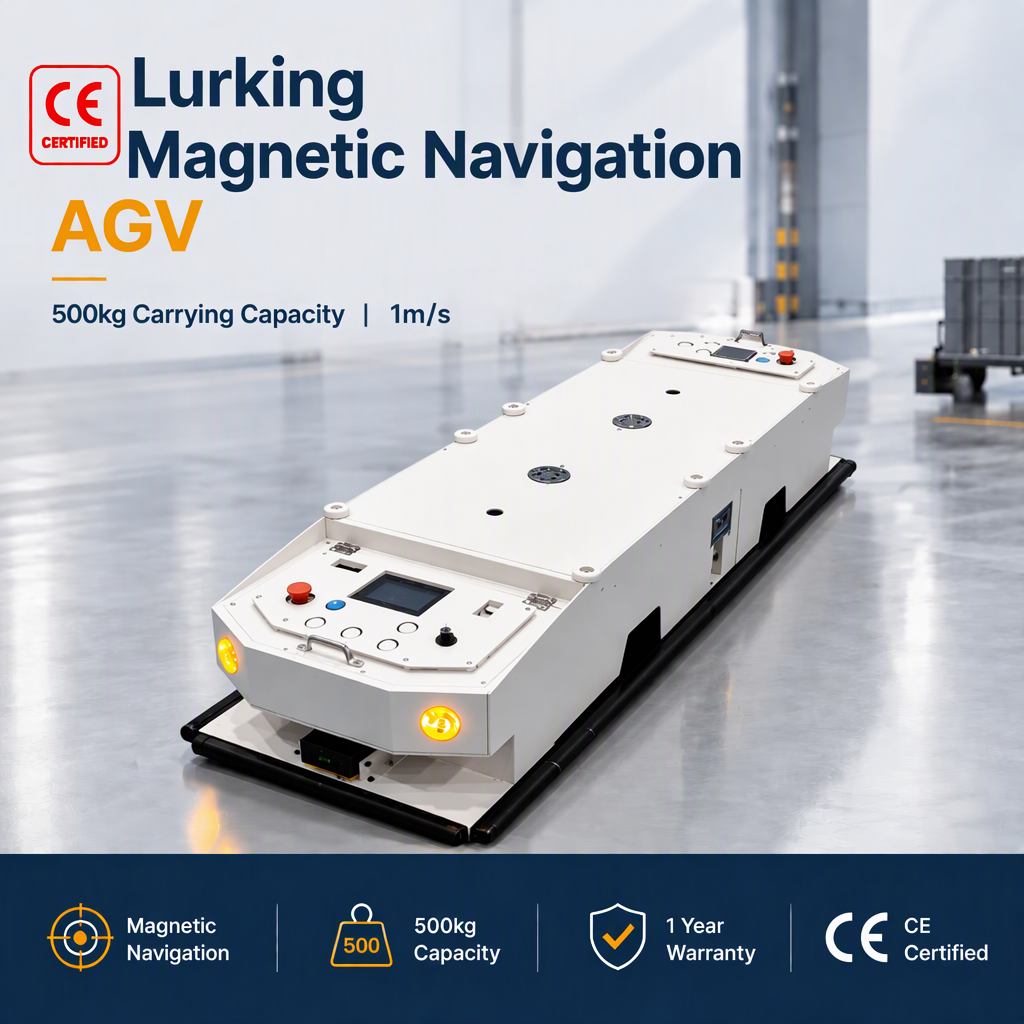
TZBOT 500 kg Bidirectional Lurking Robot
A CE-approved latent-lifting chassis with 500 kg towing capacity and magnetic navigation. It slides under existing carts, so a Philippine 3PL can automate pallet moves without replacing racking, bins or floor markings.
- 500 kg towing
- Magnetic guidance
- CE approved
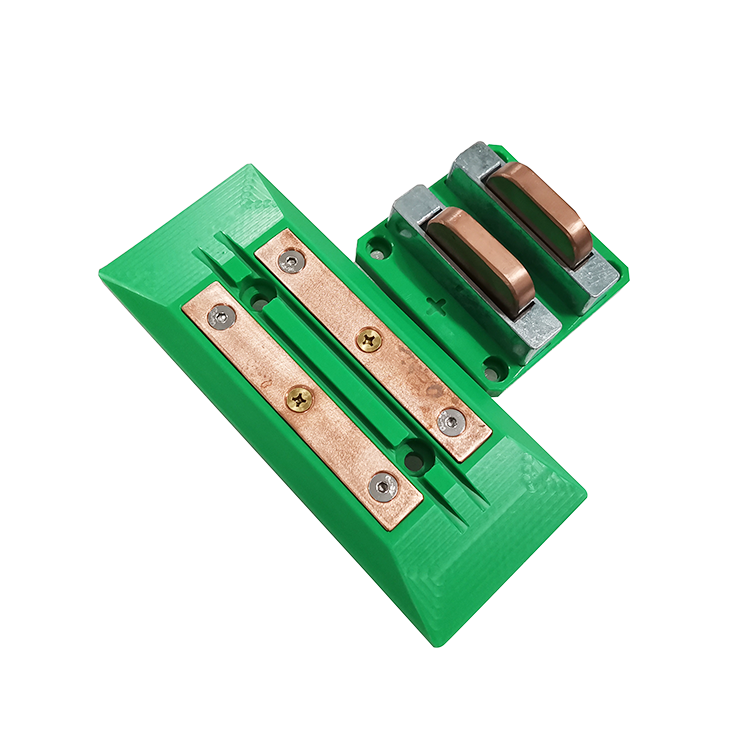
TZBOT Charger Pad TZ-CP-50A with Brush Plate
An automatic charging contact pad with a self-cleaning brush plate and brush block. In dusty Cavite and Laguna warehouses, the brush wipes the contact surface on every docking cycle, protecting charge efficiency over thousands of cycles.
- 50 A contact pad
- Self-cleaning brush
- Opportunity charging
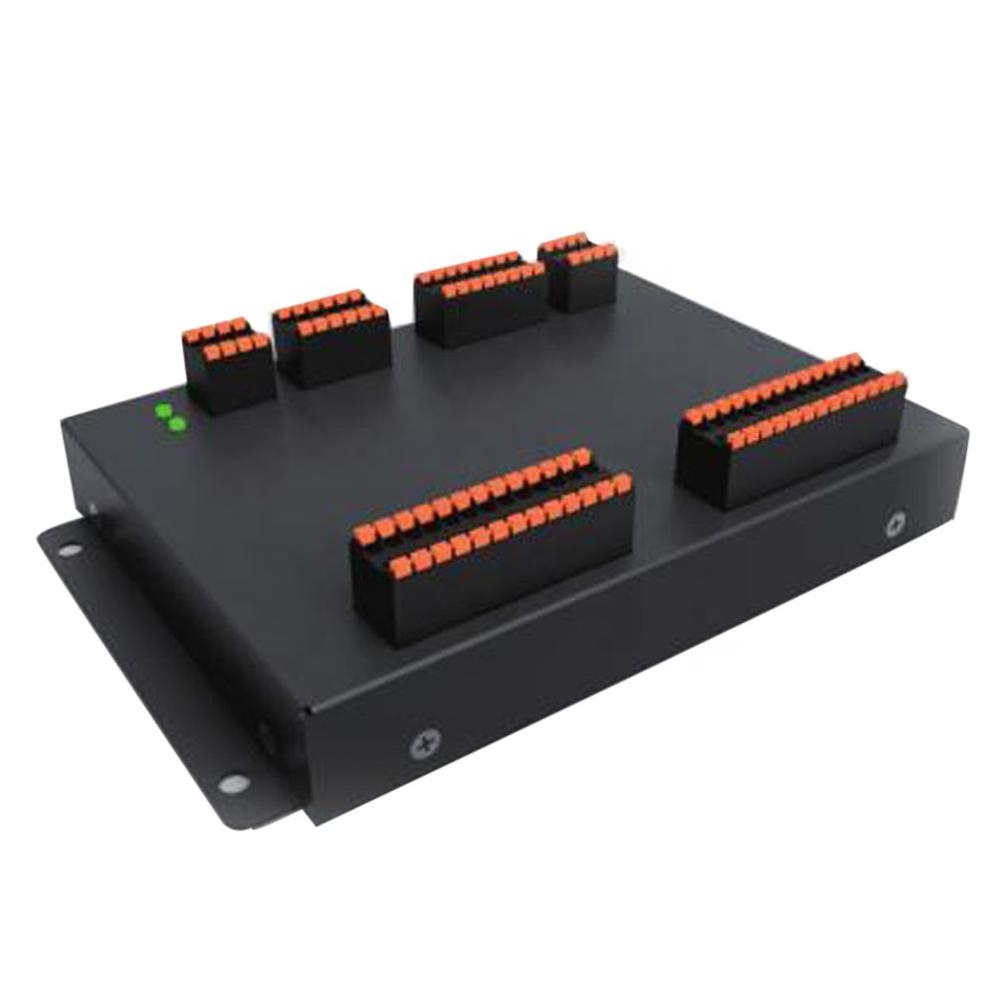
TZBOT TZC-MST-FX200D-A AGV Controller
An industrial command controller for routing, station logic and traffic management. It speaks the discrete I/O and serial language most Philippine integrators already use, shortening the PLC-to-fleet handover on a new line.
- Multi-station logic
- Industrial I/O
- Fleet routing
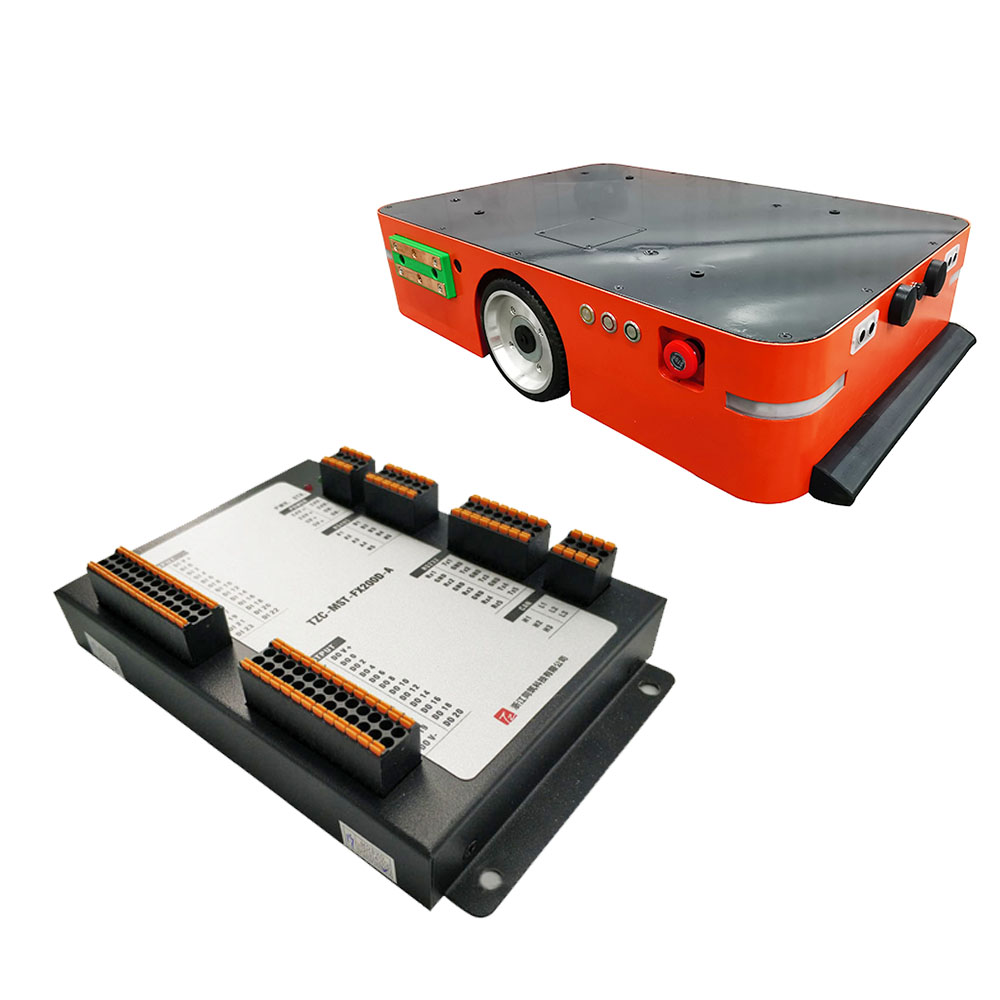
TZBOT Smart AGV Controller
A compact controller that handles path planning, task dispatch and fault reporting for small-to-mid fleets. Pair it with our drive wheels and sensors to keep the entire motion stack under a single vendor and a single warranty conversation.
- Task dispatch
- Fault diagnostics
- Single-vendor stack
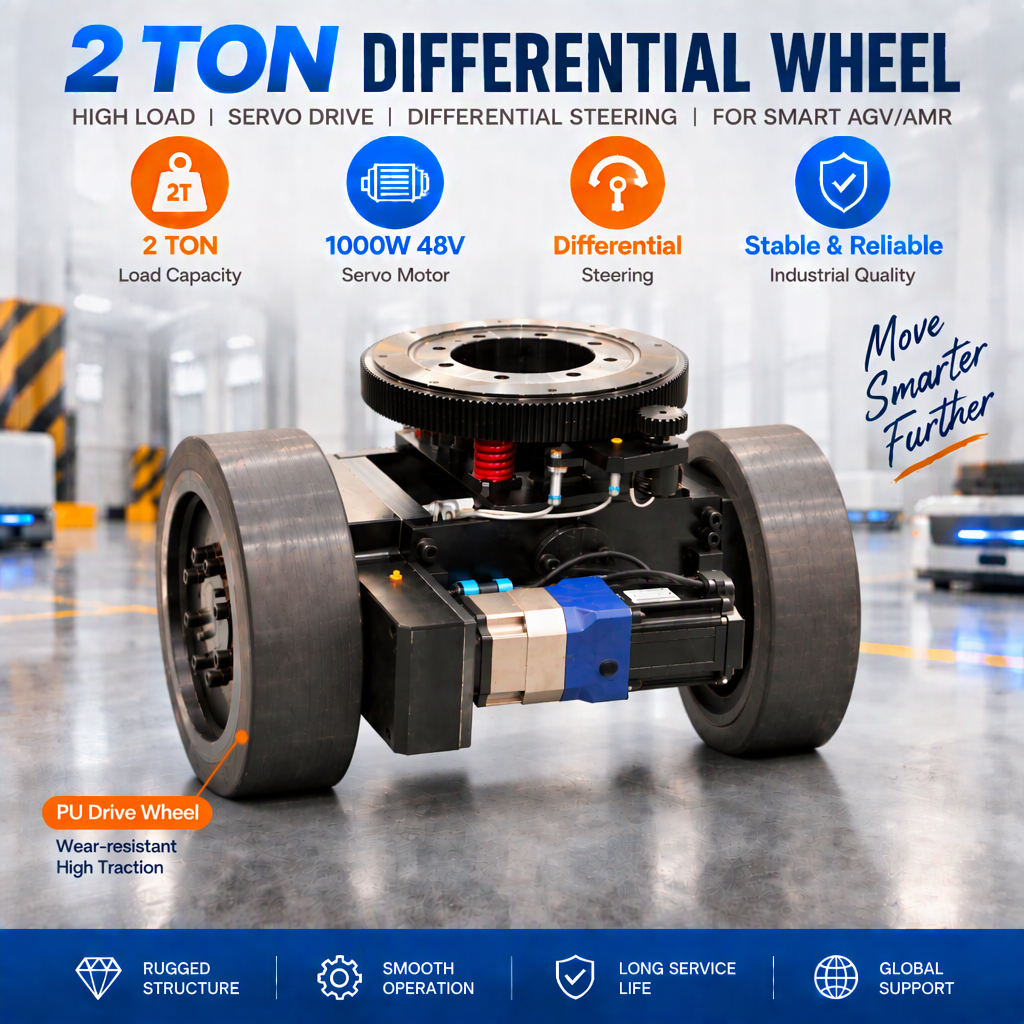
2,000 kg Differential Drive Wheel, 1000 W 48 V
A two-tonne differential drive unit with integrated suspension and a 1000 W 48 V motor. The spring travel keeps traction on the patched concrete and expansion joints common in older Metro Manila warehouses.
- 2,000 kg bearing
- 1000 W / 48 V
- Spring suspension
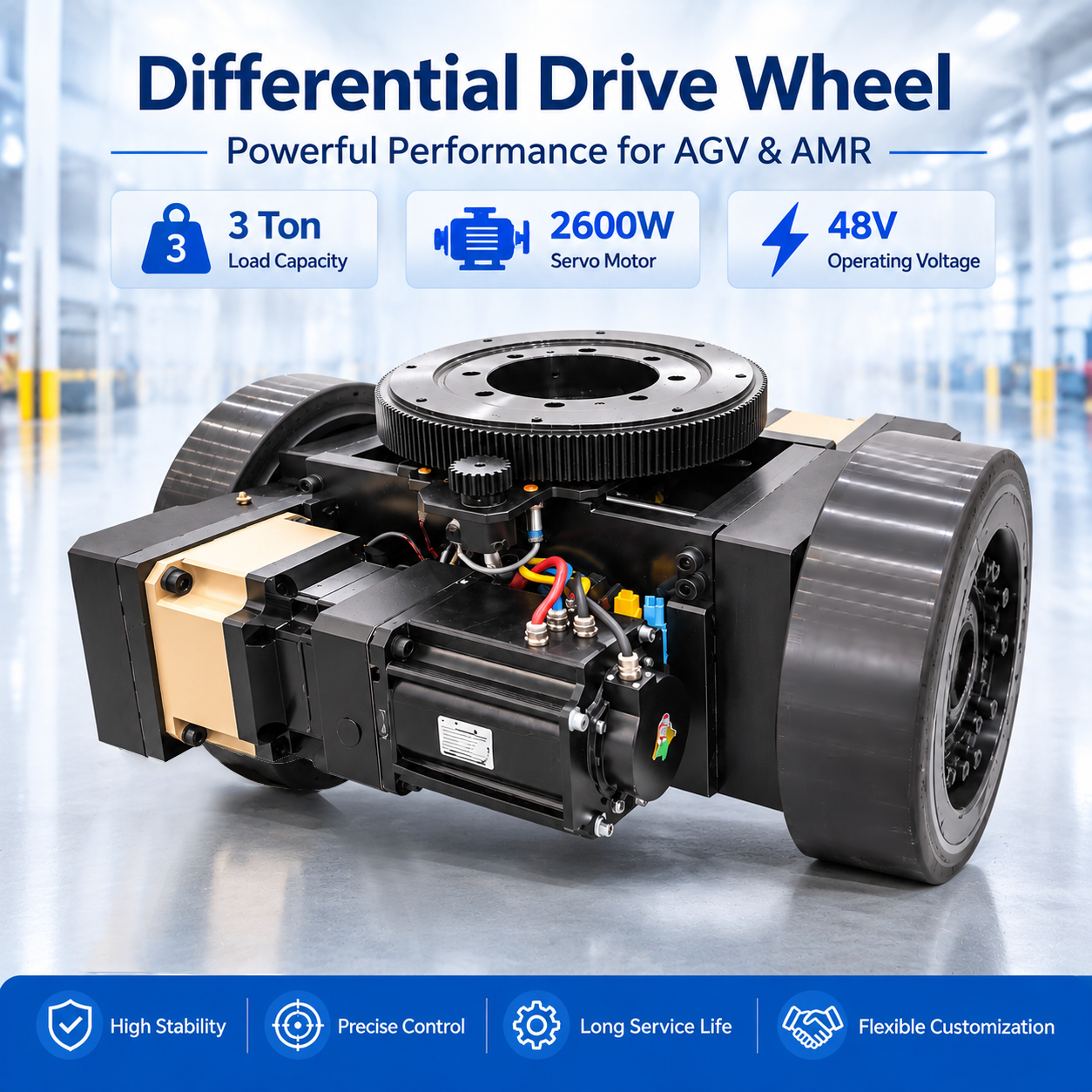
3,000 kg Differential Drive Wheel, 2600 W Servo
A three-tonne servo-driven wheel for heavy tow tractors and VNA trucks. The 2600 W 48 V motor delivers the torque needed for dock levellers and ramps at port-adjacent yards in Manila, Subic and Cebu.
- 3,000 kg load
- 2600 W / 48 V
- Servo motor
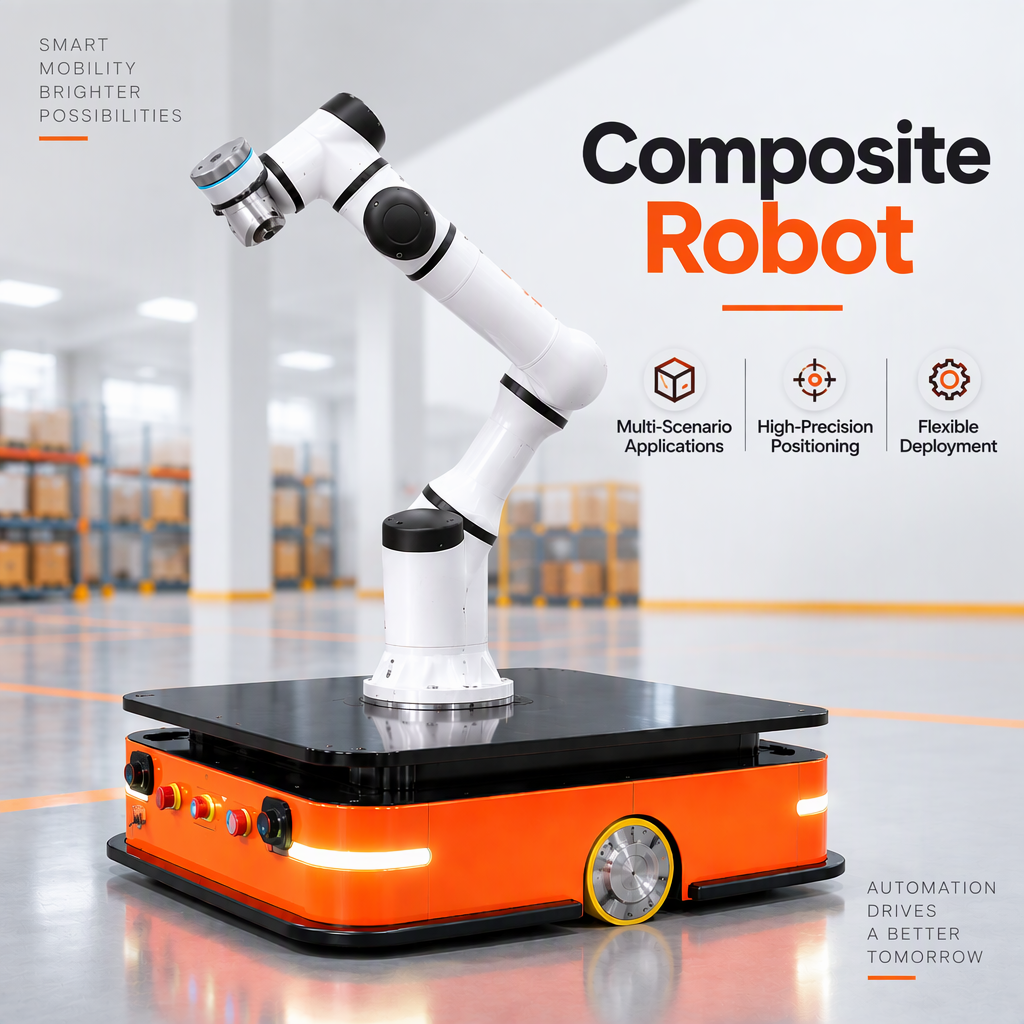
600 kg Composite Robot Chassis with Robotic Arm
A 600 kg bearing chassis that carries a collaborative or industrial arm. Built for semiconductor and electronics lines inside PEZA zones, where one platform has to do pick-and-place and point-to-point transport on the same shift.
- 600 kg bearing
- Arm-ready deck
- Cleanroom compatible
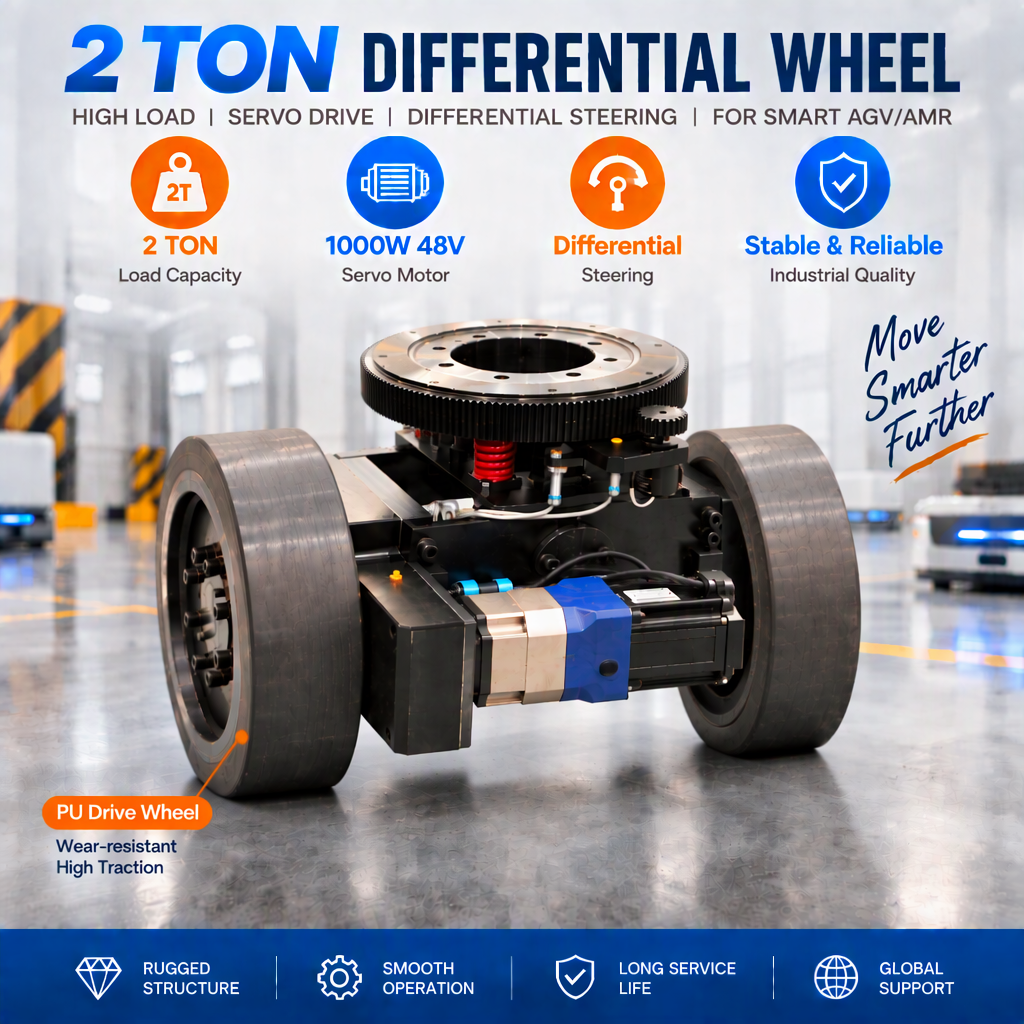
TZBOT 2000 kg Heavy Duty AGV Wheel with Spring Suspension
A spring-suspension wheel rated for 2,000 kg and continuous three-shift duty. The sealed housing and corrosion-resistant finish resist humidity and washdown in food, beverage and cold-chain plants.
- 2,000 kg rating
- 1000 W / 48 V
- Sealed housing
-
ISO 9001:2015Quality management certified
-
Intertek VerifiedOnsite factory assessment
-
8 PatentsIn-house R&D since 2015
-
4.9 / 5 RatingVerified buyer reviews
-
97.9% Reply RateGlobal export support
A Single Factory for the Whole AGV Drive Train
Most Philippine buyers do not need another catalogue. They need a supplier who answers three questions in one thread: will the drive wheel survive our floor, will the controller talk to our WMS, and will spare parts arrive before the line stops. Zhejiang Torqen Technology Co., Ltd. was built to answer all three.
Matched, Not Assembled
We design the drive wheel, motor, reducer, servo/BLDC driver and navigation sensor together. You avoid the classic failure mode of mixing three vendors who each blame the other during commissioning.
One warranty, one contactOEM / ODM Customisation
Sample-based and design-based customisation: motor power, voltage, reduction ratio, wheel diameter, tread material, encoder type, brake options and mounting interface — backed by eight awarded patents.
From drawing to prototypeTested Before It Ships
Five in-house testing instruments, finished-product inspection, and extended-duration prototype runs before any production release. Production records are traceable, so a replacement part can be matched to your original batch.
ISO 9001:2015 controlledExport-Ready Logistics
FOB, CFR, CIF, EXW, CIP, FCA, CPT, DDU and express delivery, with payment in USD, EUR, JPY, CAD, AUD, HKD, GBP or CNY. A 97.9% inquiry response rate keeps overseas projects moving across time zones.
Manila, Subic, CebuWhere AGV Robot Chassis Actually Run in the Philippines
Philippine intralogistics is not a copy of a European warehouse. Floors are older, aisles are narrower, humidity is higher and spare-part lead times are measured in weeks. These are the eight environments our chassis are configured for.
Metro Manila 3PL & E-commerce
Cross-docking and put-away in Valenzuela, Parañaque and Caloocan, where aisle width is fixed and every square metre is already paid for.
PEZA Electronics & Semiconductor
Laguna, Cavite and Batangas. A 600 kg composite chassis carries the arm and the wafer cassette, replacing two separate handling steps.
Cold Chain & Food Processing
Freezer rooms and chiller docks where condensation attacks unprotected electronics. Sealed wheels and 48 V systems hold torque at −25 °C.
Port & Customs YARDS
Manila, Subic and Cebu container yards. The 3,000 kg tow tractor handles ramps, dock levellers and rough concrete without wheel slip.
Retail & Grocery Distribution
Sari-sari store supply chains and supermarket DCs that need high-frequency, short-distance replenishment between pallet racks.
Automotive & Motorcycle Assembly
Line-side replenishment in Cavite and Laguna plants, where a 2,000 kg chassis replaces a manual tugger on every shift.
Pharma & Medical Distribution
Temperature-controlled storage and regulated picking, where a traceable fleet log matters as much as throughput per hour.
Construction Materials & Hardware
Coiled steel, cement pallets and long loads that need the 3,000 kg differential wheel, reinforced suspension and a wider tread.
Philippines AGV Trends Shaping 2025–2026 Procurement
Four shifts are changing how Philippine buyers specify a robot chassis — and each one changes what you should put in the purchase order.
E-commerce Volume Is Outgrowing Manual Picking
Lazada, Shopee and TikTok Shop have pushed fulfilment centres toward 24/7 shifts. A 500–1,000 kg towing chassis lets a 3PL add a night shift without adding headcount; the real constraint is floor space, not labour.
One Chassis, Many Tasks in PEZA Plants
Semiconductor and electronics plants increasingly deploy a composite robot — a 600 kg AMR base carrying an arm — because cleanroom floor space is expensive and re-tooling a line costs more than re-tasking a robot.
Climate Resilience Is Now a Specification
Typhoon-season flooding, humidity above 80% and salt air near Manila Bay shorten the life of unprotected electronics. Buyers now request sealed housings, conformal coating and IP-rated connectors as standard, not options.
Modular Buying Replaces Complete-Vehicle Import
More integrators buy the drive wheel, controller and charger separately and build the top module locally. It lowers landed cost, simplifies spare-part stocking and keeps payload design under local control.
How to Specify and Import an AGV Chassis into the Philippines
Matching the chassis to the job is only half the work. The other half is voltage, freight, clearance and spare-part planning — the details that decide whether the fleet is running in week six or month six.
| Intralogistics job | Recommended chassis | Payload | Navigation fit |
|---|---|---|---|
| Cart towing in a 3PL warehouse | 500 kg bidirectional lurking robot | 500 kg | Magnetic tape + RFID stations |
| Heavy tow tractor at a port yard | 3,000 kg differential drive wheel | 3,000 kg | Magnetic tape, laser SLAM optional |
| Electronics line with an arm | 600 kg composite robot chassis | 600 kg | QR grid or SLAM |
| Low-clearance under-ride cart | Horizontal drive assembly | 1,000–2,000 kg | Magnetic tape |
| Cold-room replenishment | 2,000 kg sealed suspension wheel | 2,000 kg | Magnetic tape + RFID |
| Multi-level racking transfer | 1,000 kg jacking chassis | 1,000 kg | QR + lidar avoidance |
220 V / 60 Hz Power Reality
The Philippine grid runs at 220 V and 60 Hz, so charger input and protection must be configured for it. Traction batteries stay at 24 V or 48 V DC; confirm your facility voltage and plug standard before the order is released.
Customs, VAT and PEZA Status
Import VAT and duties are assessed at the Bureau of Customs and normally paid by the importer of record. We prepare the commercial invoice, packing list, bill of lading and certificate of origin so your broker can classify the goods correctly.
Freight and Spare-Part Buffer
Sea transit is typically 7–12 days to Manila and 12–18 days to Cebu, before clearance. For fleets above ten units, hold 5–8% of active units as spare wheels, drivers or sensors — enough to absorb a repair without pausing a shift.
From Drawing to Manila Port in Six Steps
A transparent process for engineering buyers who need predictable sampling, predictable testing and a predictable shipping date.
Requirement Review
Load, speed, gradient, voltage, chassis height and floor condition assessed in one call.
Engineering Proposal
Motor, reducer, wheel diameter and tread matched; 2D and 3D drawings shared for approval.
Prototype Build
Sample-based or design-based customisation produced with your mounting interface.
Endurance Testing
Extended-duration runs, thermal checks and parameter verification before release.
Mass Production
ISO 9001:2015 controlled manufacturing with batch-level traceability.
Inspection & Delivery
Final inspection, export packing and booking to Manila, Subic or Cebu.
Questions Philippine Buyers Ask Before Ordering
Straight answers on MOQ, lead time, voltage, customs, warranty and technical support — the topics that come up in almost every inquiry from Manila, Cebu and Clark.
Are you an AGV robot chassis wholesaler or an actual manufacturer?
We are a manufacturer. Zhejiang Torqen Technology Co., Ltd. has designed and produced AGV chassis, drive wheel assemblies, motors, servo/BLDC controllers and navigation sensors since 2015. Philippine buyers can purchase factory-direct, through a local integrator, or under their own brand with OEM labelling and buyer-label packaging.
Do you ship AGV chassis and drive wheels to the Philippines?
Yes. We ship FOB Ningbo or Shanghai and can quote CFR or CIF to Manila, Subic or Cebu. Sea transit is typically 7–12 days to Manila and 12–18 days to Cebu, before Bureau of Customs clearance. Air and express options are available when a spare wheel or controller is urgent.
What is the minimum order quantity for Philippine buyers?
One unit for standard drive wheels, controllers and charger pads, so you can validate a pilot line before scaling. Custom chassis and OEM branding typically start at five units, depending on tooling, test requirements and packaging.
How long does production take before shipment?
Standard catalogue items ship in 7–15 working days after payment. Customised drive wheels with a new reduction ratio, encoder or mounting interface take 20–35 working days, including endurance testing. Add sea freight and clearance time when you plan a Manila launch date.
Are your chargers compatible with 220 V / 60 Hz Philippine power?
Yes. The Philippine grid is 220 V at 60 Hz, so we configure charger input and protection accordingly. AGV traction batteries remain 24 V or 48 V DC and the charger handles the conversion. Confirm your facility voltage, breaker capacity and plug standard when ordering.
Who handles the 12% VAT and customs duties?
Import VAT and duties are assessed at the Bureau of Customs and are normally paid by the importer of record. We provide the commercial invoice, packing list, bill of lading and certificate of origin so your broker can classify the goods correctly. PEZA-registered enterprises should confirm their incentive status with their broker before shipment.
Do you provide installation and commissioning support in the Philippines?
We supply English wiring diagrams, controller parameter files, I/O mapping tables and remote commissioning support. For multi-vehicle projects we can arrange on-site support through our regional partners; travel, scheduling and scope are quoted separately so there are no surprise charges.
How do you protect the equipment from humidity, heat and typhoon season?
Drive wheels use sealed housings and corrosion-resistant finishes, and controllers are specified with conformal coating where required. For flood-prone ground floors we recommend elevated charging stations, IP-rated connectors and a preventive maintenance schedule that includes insulation checks before and after the rainy season.
What about spare parts and warranty?
Drive wheels, controllers and sensors carry a 12-month warranty against manufacturing defects. Every batch has traceable production records, so a replacement motor, encoder or wheel tread can be matched to your original specification. For fleets, we recommend holding 5–8% of active units as critical spares.
Can the chassis integrate with our WMS, ERP or existing fleet manager?
Yes. Our controllers expose standard I/O, CAN and serial interfaces, and we provide protocol documentation. If you already run a fleet manager, share the API or Modbus/TCP register map and our engineers will confirm compatibility before you place the order.
Which payment terms and currencies do you accept?
T/T, L/C, D/P, D/A, credit card, PayPal, MoneyGram, Western Union and escrow, in USD, EUR, JPY, CAD, AUD, HKD, GBP or CNY. For first orders we usually recommend a 30% deposit with the balance against the bill of lading.
Specifying a New AGV Chassis for the Philippines?
Send your payload, speed, gradient, battery voltage and chassis height. Our engineers will match the drive wheel, servo driver, charger and navigation sensor, then quote FOB, CFR or CIF to your Philippine port.
